Band and Loop Space Maintainer: Cost, Types & Care Guide (2026)
Learn what a band and loop space maintainer is, how it prevents space loss in pediatric dentistry, fabrication steps, 2026 costs, and clinical care tips.
Reviewed on October 24, 2026 · How medical review works
Disclosure: This post contains affiliate links. If you buy through them, we may earn a small commission at no extra cost to you.
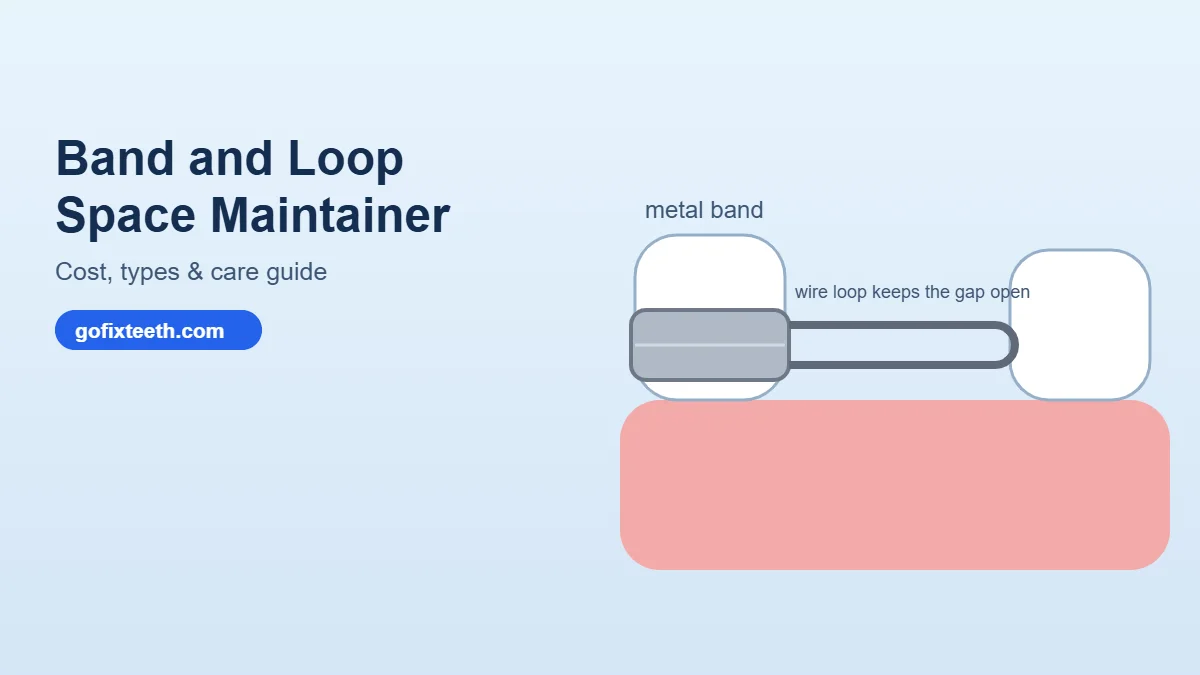
A band and loop space maintainer is a fixed unilateral dental appliance designed to preserve the arch perimeter following the premature loss of a baby tooth.
By anchoring a stainless steel band around an adjacent primary molar or permanent tooth and extending a smooth wire loop across the empty space, it prevents neighboring teeth from tipping or drifting, ensuring clinicians can reliably maintain space so permanent teeth can erupt naturally.
Key Takeaways:
- Band and loops are the most common unilateral fixed space maintainers in pediatric dentistry.
- They preserve critical dental arch length when a primary molar is extracted early due to severe caries or dental trauma.
- The appliance protects the developing dentition from dental crowding and impaction until the succedaneous bicuspid begins active eruption.
- Routine dental visits, proper oral hygiene, and avoiding sticky candies prevent cement washout and appliance dislodgement.
📩 Important: after you sign up, open the email from Go Fix Teeth and tap Confirm. Your PDF opens right away. Not there? Check Spam or Promotions.
Band and loop space maintainer:
An oral device called a band and loop space maintainer is used when one or more primary teeth are missing to maintain space between two teeth. It is frequently used in pediatric dentistry to stop neighboring teeth from moving and close the hole left by a prominent tooth that has been lost too soon due to trauma or disease.
The device comprises a metal band cemented around one tooth, usually in front of the gap, and a wire loop reaching the tooth on the other side of the space. To maintain the space for the ultimate eruption of the permanent tooth, the loop is linked to the band and is intended to prevent the nearby teeth from migrating into the open area.The appliance is used as follows:
When a child’s primary tooth has been lost too soon and has to be replaced, the dentist will assess the necessity for a space maintainer after looking at the child’s teeth.
Cleaning and removing any decay or damaged tissue will be done to prepare the teeth on each side of the gap. After that, the wire loop is linked to a metal band wrapped around the tooth in front of the gap.
Installation: The band and loop space maintainer are then affixed with cement, bridging the gap between the teeth.
A dental professional will monitor the child’s development and alter the device to keep it working correctly.
Removal: The band and loop space maintainer usually is taken out as the permanent tooth starts to show. And the time needed only depends on the developmental stage of each child’s teeth.
The band and loop space maintainer are designed to suit the child’s mouth. Therefore, regular inspection and modifications by a dental expert are required to ensure it continues to work as intended and doesn’t irritate or pain the child’s mouth.
When one or more primary teeth are missing, the gap between two teeth is maintained using a band and loop device. When a central tooth is lost too soon from disease or trauma, the surrounding teeth may migrate and shift into the vacant area. This may result in many dental difficulties, including crowding, misalignment, and bite abnormalities.
These issues are avoided using the band and loop space maintainer, which keeps the gap open and stops the neighboring teeth from moving. The permanent tooth can erupt into the proper place without interference from neighboring teeth by preserving the spacing.
As children often lose their primary teeth at this time, the band and loop space maintainer is frequently utilized in pediatric dentistry. Preventing dental issues resulting from early tooth loss is a relatively easy and affordable approach. It is designed specifically for the child’s mouth and is typically worn until the permanent tooth erupts.
Generally, the band and loop space maintainer is employed to encourage healthy dental growth and guard against possible issues brought on by early tooth loss. To guarantee that children have healthy, appropriately positioned teeth as they develop and grow, it is an efficient and often utilized method in pediatric dentistry.
Band and loop space maintainer price:
band and loop space maintainer price might vary based on several variables, including your geographic location, how complicated the operation is, and the dentist practice where you have the treatment. Also, the price may change depending on whether the device is bonded to one or several teeth.
A band and loop space maintainer typically costs $250 to $500 per tooth. However, this might change based on your region and unique circumstances.
To get a tailored estimate for the cost of the appliance based on your unique demands and oral health, it is vital to speak with your dentist.
Depending on the specific plan and the appliance’s intended use, some dental insurance policies may partially or entirely cover a band and loop space maintainer’s price.
To find out what coverage is offered for this kind of therapy, it is advised that you contact your dental insurance company.
Band and loop space maintainer fabrication:
A band and loop space maintainer fabrication is generally in some steps using different parts.
The steps involved in the fabrication process are summarized as follows:
To produce a model of the child’s mouth, the dentist imprints the child’s teeth and assesses the necessity for a space maintainer.
Model Creation: A plaster model of the teeth is made from the imprint and utilized to design a metal band specifically tailored to suit the patient’s teeth.
Metal bands are fabricated by utilizing a cast of the child’s tooth that has to be banded.
The band is usually crafted from stainless steel or similar material, sized and formed to fit precisely around the tooth
The loop connecting the band to the tooth on the other side of the gap is made of a wire bent and formed into the desired shape.
Attachment: The band is fastened to the wire loop, and the complete device is then expertly adjusted to achieve a good fit.
Cementing: The band and loop space maintainer are placed with cement, bridging the gap between the teeth.
The manufacturing procedure sometimes necessitates several sessions with a dentist or orthodontist to ensure that the appliance fits correctly and is comfortable for the patient.
To ensure the device remains functional and doesn’t irritate the mouth or create discomfort, it may be essential to monitor it frequently and make modifications.
Why space maintenance matters in pediatric dentistry
The primary goal of proactive space maintenance is to avoid rapid space loss after premature tooth loss. When a child experiences early loss of a deciduous molar, the posterior teeth naturally tilt forward toward the mesial void.
Research published through the American Academy of Pediatric Dentistry (AAPD) confirms that dental arches experience the quickest dimensional collapse within the first six months following an extraction. When molars drift unchecked, future teeth are blocked, leading to complex orthodontic dilemmas that may require long-term braces or appliances later in adolescence.
You can learn more about general orthodontic timelines in our detailed guide on how long you have to wear braces.
Before any device is chosen, clinicians obtain diagnostic radiographs to gauge root maturity. Parents wondering about diagnostic safety can consult our guide on an xray of child’s teeth to see how pediatric dentists evaluate eruptive pathways beneath the gums.
Comparing band and loops to other appliances: distal shoe and lingual arches
While band and loops are standard for unilateral single-tooth spaces, different clinical presentations call for specialized appliances. Pediatric dentists classify these options based on the dental quadrant, stage of dental transition, and whether both sides of the jaw require support:
- Band and loop maintainers: Ideal for single tooth gaps where an erupted abutment molar exists both anterior and posterior to the missing unit or directly behind it.
- Distal shoe maintainer: When a second primary molar is lost before the permanent first molar has broken through the surface, a distal shoe appliance is indicated. It features a subgingival extension that guides the unerupted tooth into healthy alignment.
- Lower lingual holding arch (LLHA): When bilateral space loss threatens the mandibular arch, a lingual holding arch connects both sides with a contoured wire running along the inside surfaces of the lower anterior teeth.
- Transpalatal arch (TPA): Spanning the roof of the mouth, this stabilizes upper permanent molars to prevent rotation or tipping after bilateral loss in the maxillary arch.
The functional band and loop space maintainer
A traditional band and loop is considered non-functional because the wire loop rests open across the edentulous ridge without offering a chewing surface. In contrast, a functional band and loop space maintainer adds an acrylic occlusal block or an artificial resin crown onto the wire framework.
This specialized functional band and loop restores chewing performance, stops the opposing upper or lower tooth from over-erupting into the space, and improves aesthetics for young patients.
Maintaining pristine oral hygiene around any soldered appliance is essential to prevent inflammation in the surrounding gingiva. Pediatric electric brushes help young children clear trapped debris along the band margins easily.

Philips Sonicare for Kids Rechargeable Electric Toothbrush
Why it helps: Maintaining plaque control around metal bands and orthodontic wires is critical to avoid decay on abutment teeth.
- Gentle Modes: Features low and high power settings calibrated specifically for growing mouths.
- KidTimer Coaching: Gradually builds brushing time to the research-backed two minutes.
- Interactive App: Keeps kids motivated to clean thoroughly along gumlines and appliance margins.
Detailed chairside workflow and cementation
Modern pediatric practices may choose between traditional laboratory-based workflows and preformed universal chairside kits. Whether customized on a stone cast or bent directly in the operatory, the clinician must ensure the loop hugs the soft tissues without pressing painfully into the mucosa.
The dental technician or clinician uses high-grade orthodontic wire and dental solder to fuse the contoured loop to the stainless steel band. Once fitted, the final cementation is performed using biocompatible glass ionomer cement. Glass ionomer forms a chemical bond to enamel while continually releasing fluoride, which protects the anchor tooth from marginal demineralization.
Daily flossing alongside appliance bands is vital to protect neighboring dental structures. Using dedicated floss picks designed for smaller arches helps kids reach back teeth without dislodging the hardware.

Plackers Kids Dental Flossers (Fruit Smoothie Flavor)
Why it helps: Interdental cleaning beside cemented bands prevents localized gingival inflammation and interproximal cavities.
- TufFloss Wire: Engineered not to stretch, shred, or snap against snug pediatric contact points.
- Kid-Friendly Grip: Angled head makes reaching posterior primary molars simple for small hands.
- Fluoride Coated: Supports enamel remineralization in tight spaces prone to food traps.
If your child underwent an extraction prior to appliance placement, review our visual guide covering day-by-day tooth extraction healing stages with pictures to make sure the extraction socket is completely healed before seating the metal loop.
When to see a professional
Parents should inspect their child’s space maintainer weekly. Contact your pediatric dentist promptly if you notice any of the following warning signs:
- The stainless steel band feels loose, rocks when touched, or slides up and down the tooth.
- The wire loop breaks away from the solder joint or becomes bent out of shape.
- The gum tissue beneath the loop appears red, swollen, or begins growing over the wire.
- Your child reports sudden localized pain, sensitivity, or bad breath around the cemented band.
- The adult replacement tooth begins cutting through the gum tissue beneath or beside the loop.
Instant PDF · $12
The Dental Recovery & Savings Bundle
A day-by-day recovery calendar (what’s normal, what to eat, when to call your dentist) plus 4 word-for-word scripts to lower your next dental bill. 30-day money-back promise.
Get the bundle →Frequently Asked Questions
What is a band and loop space maintainer used for?
A band and loop space maintainer is an orthodontic appliance designed to hold open dental arch space following the premature loss of a baby molar. It ensures neighboring teeth do not tilt into the gap, allowing the underlying permanent tooth room to erupt smoothly.
How long does a band and loop space maintainer stay in?
It typically stays in place until the adult tooth begins breaking through the gum tissue. Depending on child age and dental eruption schedules, this can range from six months to a few years.
What are the disadvantages of a band and loop space maintainer?
The primary drawbacks are lack of chewing surface (in conventional non-functional models), vulnerability to solder joint breakage if hard candies are chewed, and potential plaque accumulation that requires diligent brushing.
When do you use band and loop?
A band and loop is used primarily for unilateral space maintenance when a single primary molar is missing and adjacent teeth are fully erupted and strong enough to support the band.
This article is for informational purposes only and is not a substitute for professional advice. Consult a qualified professional for personal recommendations.