

Black Tooth: Causes, What It Means & Treatment Costs
Black tooth causes explained: decay, a dead tooth after injury, tartar, stains, old fillings and iron. What each looks like, treatments, costs and urgency.
✅ Quick answer
A black tooth is most often caused by tooth decay, a dead (necrotic) nerve after an injury, tartar buildup, surface stains from coffee, tea, tobacco or liquid iron supplements, or an old silver (amalgam) filling showing through. Some causes are cosmetic, but decay and a dying nerve need treatment, so see a dentist soon, and urgently if you have pain, swelling, a pimple on the gum or fever.
Noticing a black spot, a dark line, or a whole tooth turning gray or black can be alarming. The color alone does not tell you the cause. A tiny black dot in a groove may be a harmless stain, while a front tooth slowly darkening after a fall years ago may mean the nerve inside has died.
Only a dentist can tell for sure, usually with an exam and X-rays. This guide explains the common causes of a black tooth, how each typically looks, the usual treatments and rough costs, and the signs that mean you should not wait.
📩 Important: after you sign up, open the email from Go Fix Teeth and tap Confirm. Your PDF opens right away. Not there? Check Spam or Promotions.
Common causes of a black tooth

- Tooth decay (cavities). Decay starts as chalky white or brown spots and can turn dark brown or black as it breaks down the tooth. It often begins in the grooves of back teeth, between teeth, or along the gum line.
- Dead or dying nerve (pulp necrosis). A blow to the tooth, even one you barely remember, can damage the nerve and blood supply. Over weeks to months, the tooth may turn gray, dark brown or black from the inside.
- Tartar (calculus). Hardened plaque is usually yellow or tan, but tartar below the gum line can look dark brown or black, often as a band near the gums.
- Surface stains. Coffee, tea, red wine, cola, tobacco and some mouth rinses can leave dark stains, especially in pits and grooves.
- Liquid iron supplements. Liquid iron can leave black stains on teeth, particularly in children. These are on the surface and usually clean off at the dentist.
- Old fillings and crowns. Silver amalgam fillings can darken over time and make the surrounding tooth look gray. Metal under some crowns can show as a dark line at the gums.
Less common causes include certain medicines taken during tooth development, and a type of dark stain from mouth bacteria seen in some children. If a dark area is spreading or appeared quickly, have it checked rather than guessing.
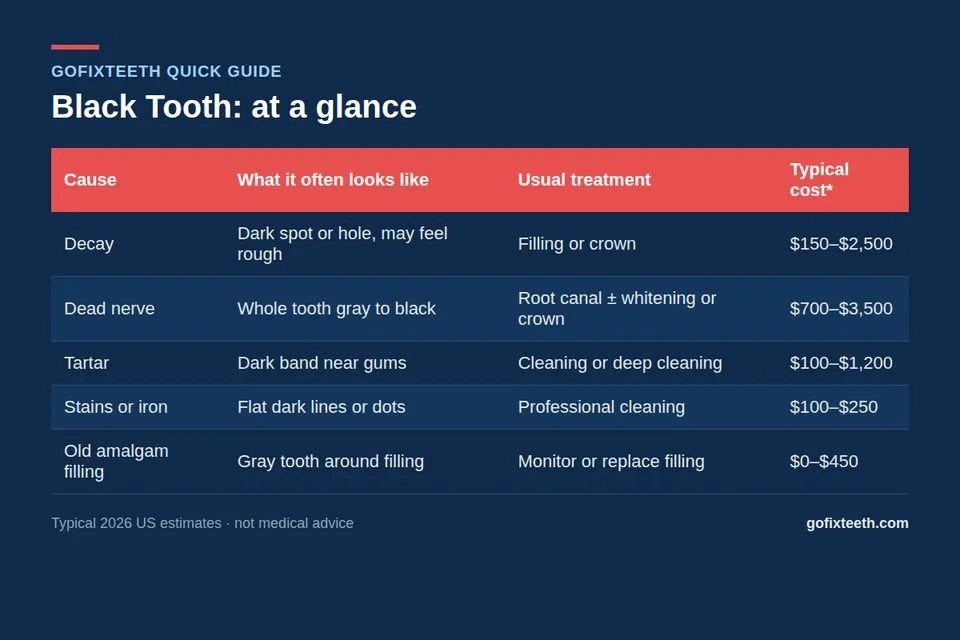
Black tooth causes compared
| Cause | What it often looks like | Usual treatment | Typical cost* |
|---|---|---|---|
| Decay | Dark spot or hole, may feel rough | Filling or crown | $150–$2,500 |
| Dead nerve | Whole tooth gray to black | Root canal ± whitening or crown | $700–$3,500 |
| Tartar | Dark band near gums | Cleaning or deep cleaning | $100–$1,200 |
| Stains or iron | Flat dark lines or dots | Professional cleaning | $100–$250 |
| Old amalgam filling | Gray tooth around filling | Monitor or replace filling | $0–$450 |
*Typical 2026 US estimates, vary by region and insurance. Many insurance plans cover cleanings at or near 100% and fillings and root canals partly.
What each cause tends to look like
Decay
A cavity may start as a small dark dot in a groove that catches floss or food. As it grows, you may feel a rough edge or hole, notice sensitivity to sweets or cold, or see the dark area spread. Decay near the gums can look like a brown or black line where tooth meets gum. Our guide to tooth decay at the gum line, with pictures shows how this often looks. Some people also notice a bad odor; see tooth decay smell.
Dead tooth after trauma
A tooth with a dead nerve usually darkens as a whole, often starting pink, yellow or gray and getting darker. It is most common on a front tooth after a fall, sports injury or accident. It may not hurt at all, or it may have been sore at the time and then quieted down. Even without pain, a dead nerve can lead to an infection at the root tip.
Tartar
Tartar feels hard and cannot be brushed or flossed away. Dark tartar under the gums often comes with gum bleeding, puffy gums or bad breath, which are signs of gum disease.
Stains, iron and fillings
Surface stains are flat, follow the shape of the tooth, and do not feel like a hole. Iron stains in children often appear as dark lines near the gums. A tooth with a large silver filling may look gray all over because the metal shows through thin enamel.
Treatments for a black tooth
Professional cleaning
If the dark color is tartar, surface stain or iron stain, a dental cleaning and polishing usually removes it. Tartar under the gums with gum disease may need a deep cleaning (scaling and root planing). See how much a dental cleaning costs without insurance for current price ranges.
Fillings and crowns
Small to medium cavities are treated by removing the decay and placing a filling, often a tooth-colored composite. If decay has destroyed a large part of the tooth, a crown may be needed to protect what is left.
Root canal
When the nerve has died or is infected, a root canal cleans out the inside of the tooth and seals it. This can save the tooth and stop infection. A darkened front tooth can then sometimes be lightened from the inside (internal bleaching), or covered with a crown or veneer. Many people worry about the pain, but modern root canals are usually done with good numbing; learn more in does a root canal hurt.
Extraction
If a tooth cannot be saved, it may need to be removed and later replaced with an implant, bridge or partial denture.
Cosmetic options
For healthy teeth that are just dark, options include professional whitening (which works best on surface and age-related stains, and less on gray teeth from fillings or dead nerves), bonding or veneers. Whitening will not fix decay, so it should come after any needed treatment.
When a black tooth is urgent
See a dentist within a day or two if you have:
- Toothache, especially throbbing pain or pain that wakes you at night
- Pain when biting or tapping on the tooth
- A pimple-like bump on the gum near the tooth, or a bad taste that keeps coming back
- A tooth that darkened after a recent injury
- A hole or broken area you can feel with your tongue
Seek emergency care the same day for facial or jaw swelling, fever, swelling spreading toward the eye or neck, or trouble swallowing or breathing. These can be signs of a spreading dental infection, which can become serious.
If pain is keeping you up while you wait for an appointment, our guide on extreme tooth pain at night explains safe short-term relief.
The Dental Recovery & Savings Bundle includes 4 word-for-word scripts to ask for a cash discount, get an itemized estimate, check what insurance really covers and set up a payment plan, plus a printable recovery calendar for after treatment. Instant PDF, $12, 30-day money-back promise.
Get the savings bundle →
What not to do
- Do not try to scrape black spots off with pins, knives or metal tools. You can damage enamel and gums.
- Do not rely on whitening strips to fix a black spot until a dentist rules out decay.
- Do not ignore a painless dark tooth. A dead nerve or deep cavity can be quiet for months and still lead to infection.
- Do not use charcoal powders or harsh scrubs to remove stains; they can wear down enamel.
How to prevent dark teeth
- Brush twice a day with fluoride toothpaste and clean between teeth daily
- Limit sugary snacks and drinks, especially sipping them throughout the day
- Rinse with water after coffee, tea or red wine
- Avoid tobacco
- For liquid iron, ask your doctor or pharmacist about rinsing or brushing after doses
- Wear a mouthguard for contact sports
- Keep up regular checkups and cleanings so small problems are caught early
Frequently asked questions
Can a black tooth be saved?
Often, yes. Stains and tartar clean off, cavities can be filled, and a dead nerve can often be treated with a root canal. A tooth that is badly broken down may need to be removed.
Is a black spot on a tooth always a cavity?
No. It can be a stain in a groove. But it can also be early decay, so have a dentist check it, especially if it is growing or sensitive.
Why did my front tooth turn black after an injury?
A hit can damage the nerve and blood supply inside the tooth. As the nerve dies, the tooth can darken. See a dentist, because a dead nerve may need a root canal.
Can a black tooth make you sick?
A dark tooth from decay or a dead nerve can become infected. A spreading dental infection can affect your health, so get urgent care for swelling or fever.
Will whitening fix a black tooth?
Whitening helps surface stains but usually does not fix decay, gray teeth from metal fillings, or most dead teeth. A dentist can suggest the right option.
Sources
- Mayo Clinic. Cavities/tooth decay.
- Cleveland Clinic. Cavities.
- Cleveland Clinic. Root Canal.
- Mayo Clinic. Tooth abscess.
- MedlinePlus. Tooth Disorders.
This article is for general education and does not replace an exam by your dentist, who can find the cause of a dark tooth with an exam and X-rays.


