Dental Filling Cost in 2026: Prices by Material and Surface
How much is a dental filling in 2026? Amalgam, composite, glass ionomer and inlay prices by number of surfaces, with and without insurance, plus ways to save.
✅ Quick answer
A dental filling typically costs about $100 to $300 for a silver (amalgam) filling and about $130 to $450 for a tooth-colored (composite) filling without insurance in the US in 2026, depending on how many surfaces of the tooth are involved. Gold or porcelain inlays and onlays cost much more, often $700 to $1,800 per tooth. With insurance, many people pay roughly $20 to $150 for a basic filling. Typical 2026 US estimates; they vary by region and insurance.
Fillings are the most common way dentists repair a cavity. Once decay has made a hole in the enamel, the tooth can’t fix it on its own, so the dentist removes the decayed part and fills the space. The good news is that a filling caught early is one of the least expensive treatments in dentistry.
The price depends on three main things: the material, how big the filling is (measured in tooth “surfaces”), and your insurance. This guide breaks down typical dental filling costs, explains what each material is good for, and covers when a crown makes more sense than another filling.
📩 Important: after you sign up, open the email from Go Fix Teeth and tap Confirm. Your PDF opens right away. Not there? Check Spam or Promotions.
How much is a dental filling? (2026 prices)
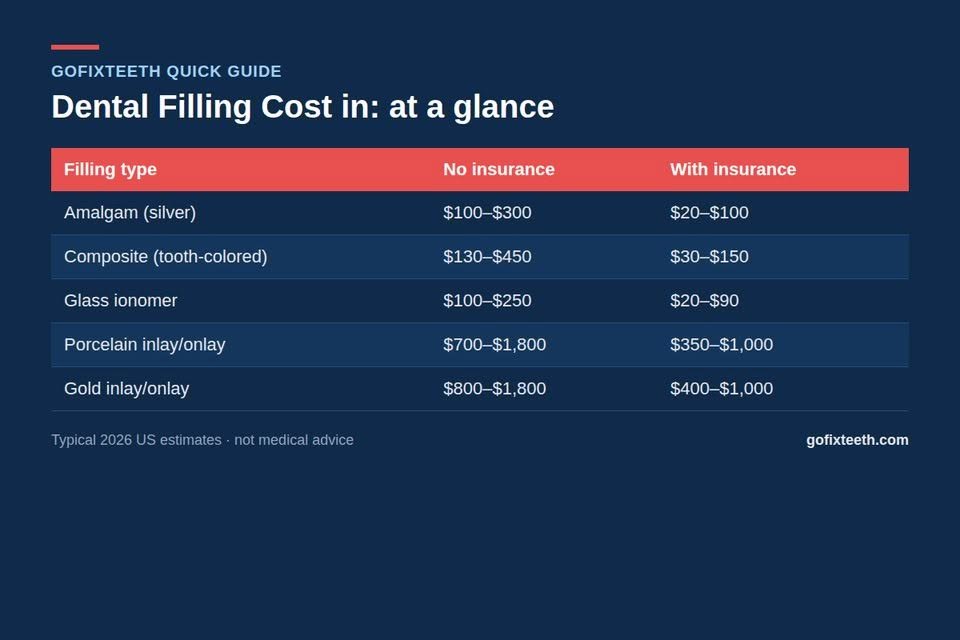
| Filling type | No insurance | With insurance |
|---|---|---|
| Amalgam (silver) | $100–$300 | $20–$100 |
| Composite (tooth-colored) | $130–$450 | $30–$150 |
| Glass ionomer | $100–$250 | $20–$90 |
| Porcelain inlay/onlay | $700–$1,800 | $350–$1,000 |
| Gold inlay/onlay | $800–$1,800 | $400–$1,000 |
Typical 2026 US estimates; they vary by region and insurance. “With insurance” assumes a common plan that pays about 70% to 80% of basic fillings after the deductible, and about 50% for inlays and onlays. Some plans pay composite fillings on back teeth only at the amalgam rate, which leaves you to cover the difference.
Why the number of surfaces matters
Dentists bill fillings by how many sides of the tooth the filling touches. A back tooth has five surfaces: the chewing surface, the cheek side, the tongue side and the two sides that face neighboring teeth. A small cavity on the top of a molar is a one-surface filling. A cavity that wraps from the top into the space between two teeth might be two or three surfaces.
Each extra surface takes more time and material, so the price climbs. As a rough guide for a composite filling without insurance:
- One surface: about $130–$275
- Two surfaces: about $170–$350
- Three or more surfaces: about $200–$450
Amalgam follows a similar pattern but usually starts lower. Typical 2026 US estimates; they vary by region and insurance. Front teeth and back teeth can also be priced differently, since composite on a molar has to handle heavier chewing.
Filling materials compared
Amalgam (silver) fillings
Amalgam is a mix of metals, including mercury bound with silver, tin and copper. It’s strong, lasts many years and is usually the lowest-cost option for back teeth. The FDA considers amalgam fillings safe for most people, but it recommends that certain higher-risk groups, such as pregnant women and people with certain health conditions, consider other materials when appropriate. Existing amalgam fillings in good shape generally don’t need to be removed. Fewer offices place amalgam today, so ask if it’s offered.
Composite (tooth-colored) fillings
Composite is a resin material matched to your tooth shade and bonded to the tooth. It looks natural, lets the dentist remove less healthy tooth structure, and is the usual choice for front teeth. It can be more technique-sensitive, may wear or stain a bit faster, and usually costs more than amalgam.
Glass ionomer
Glass ionomer releases small amounts of fluoride and bonds to the tooth. It’s often used for small fillings near the gumline, root cavities, baby teeth and for people at high risk of decay. It’s not as strong as composite or amalgam, so it’s less common on chewing surfaces of adult molars.
Inlays and onlays (gold or porcelain)
When a cavity is too big for a regular filling but the tooth doesn’t need a full crown, a dentist may suggest an inlay (inside the cusps) or onlay (covering one or more cusps). They’re made in a lab or with an in-office milling machine and then cemented. They last a long time and protect weak teeth well, but cost several times more than a direct filling.
Useful on Amazon for this job
As an Amazon Associate we earn from qualifying purchases. Always confirm fit for your exact vehicle or ask your dentist.
The Dental Recovery & Savings Bundle includes 4 ready-to-use scripts to lower your dental bill, so you know exactly what to say when you ask about cash prices, phasing treatment or a payment plan for several fillings. You also get a printable day-by-day recovery calendar for after bigger work like a crown or root canal. Instant PDF, $12, 30-day money-back promise.
Get the savings scripts →
Does insurance cover fillings?
Almost all dental plans cover fillings. They’re usually listed as a basic service, commonly paid at around 70% to 80% after the deductible. A few points to check:
- Composite on back teeth. Some plans “downgrade” composite on molars and pay only what they would for amalgam.
- Waiting periods. New plans sometimes have a waiting period of a few months for basic services.
- Annual maximum. Several fillings plus other work can use up your yearly limit.
- Medicaid. Fillings are covered for children under Medicaid and CHIP. Adult dental coverage varies by state.
- Medicare. Original Medicare generally doesn’t cover fillings, but some Medicare Advantage plans include dental benefits.
What else may be on the bill
- Exam and X-rays, often about $50–$250 without insurance, if you haven’t had them recently
- Numbing is normally included in the filling fee
- Nitrous oxide (laughing gas), if you want it, often adds about $50–$150
- A protective base or liner under a deep filling is sometimes billed separately
Typical 2026 US estimates; they vary by region and insurance.
What happens during a filling appointment
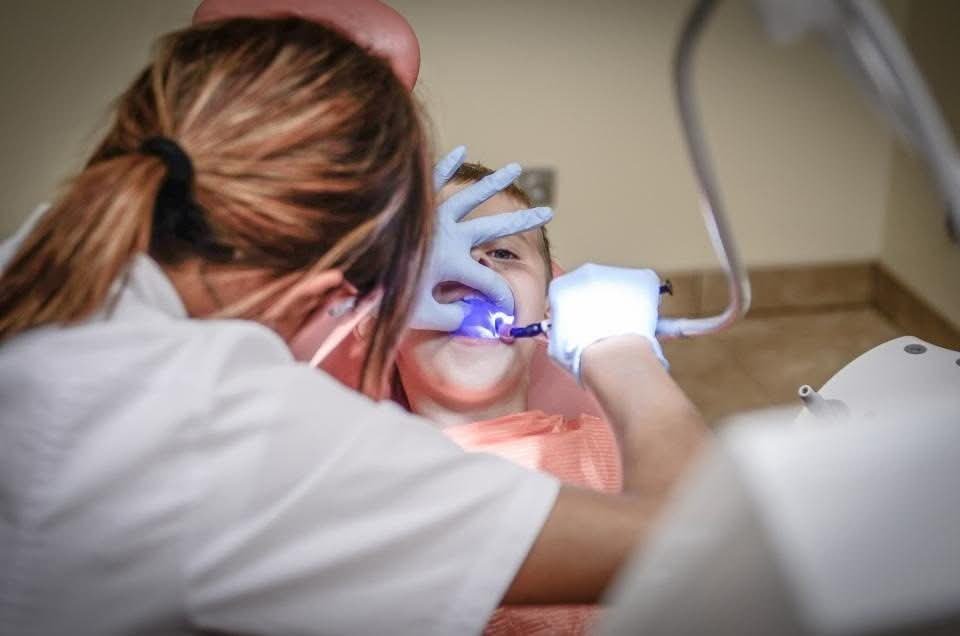
Most fillings take about 30 to 60 minutes. The dentist numbs the area, removes the decay with a drill or other instruments, cleans the space and places the filling material. Composite is added in layers and hardened with a blue light, while amalgam is packed in and carved to shape. Finally, the dentist checks your bite and smooths any high spots.
Expect the numbness to last a few hours, so wait to eat until it wears off. Mild sensitivity to cold or biting for a few days to a couple of weeks is common, especially after a deep filling. If the tooth feels “high” when you bite, or the sensitivity gets worse instead of better, call the office. A quick bite adjustment is usually included in the original fee.
When a crown is needed instead
A filling works best when there’s plenty of healthy tooth left around it. When a cavity is very large, a dentist may recommend a crown, which covers the whole tooth, usually at a much higher cost. Signs a crown may be the better choice include:
- The cavity takes up more than about half of the tooth’s width
- A cusp (one of the pointed corners of a back tooth) is cracked or broken
- The tooth has had a root canal, especially a molar
- An old, large filling keeps breaking or getting new decay around the edges
An onlay can sometimes be a middle option, saving more tooth than a crown. If cost is the main concern, ask your dentist which option protects the tooth for the lowest long-term cost.
Ways to pay less for a filling
- Get cavities treated while they’re small. A one-surface filling costs far less than a crown or root canal later.
- Ask for the cash price if you don’t have insurance.
- Community health centers offer sliding-scale fees based on income; search through HRSA.
- Dental schools often charge lower fees for supervised care.
- Dental discount plans can lower prices at member offices.
- Use an FSA or HSA for pre-tax payment.
If you need several fillings, ask your dentist which ones are most urgent. Deep cavities close to the nerve usually come first, while small, shallow spots can sometimes be scheduled later or watched with extra fluoride. Spreading work over a few months, or across two insurance plan years, can make the cost easier to manage without letting decay get worse.
See a dentist promptly if…
- A tooth is sensitive to sweets, hot or cold, or hurts when you bite
- You can see or feel a hole, dark spot or rough edge on a tooth
- A filling fell out or cracked
- Pain lingers after a hot or cold drink, or wakes you up at night
Seek emergency care right away, or call 911, for facial swelling that is spreading, fever with tooth pain, or trouble swallowing or breathing.
Frequently asked questions
How much is a filling without insurance?
Typically about $100 to $300 for amalgam and $130 to $450 for composite in the US in 2026, depending on the number of surfaces.
Why are tooth-colored fillings more expensive?
Composite takes longer to place because the tooth must be kept dry and the material is added and hardened in layers. The material also costs more.
How long do fillings last?
Many fillings last 10 years or more. Size, location, grinding and how well you prevent new decay all matter.
Can I get a cheap filling at a dental school?
Often, yes. Dental schools usually charge lower fees, though visits can take longer.
Do I need to replace my old silver fillings?
Not usually. Amalgam fillings that are intact and free of decay can generally be left in place.
Is a filling covered at 100% by insurance?
Rarely. Most plans pay around 70% to 80% of basic fillings after the deductible, while preventive cleanings are often covered at 100%.
Sources
- Cleveland Clinic. Dental Fillings.
- U.S. Food and Drug Administration. Dental Amalgam Fillings.
- Cleveland Clinic. Cavities.
- MedlinePlus. Tooth Decay.
- National Institute of Dental and Craniofacial Research. Finding Low-Cost Dental Care.
This article is for general education and does not replace advice from your dentist, who can examine your tooth and give you an exact quote.