
Tooth Extraction Cost Without Insurance (2026 US Prices)
How much is a tooth extraction in 2026? Simple, surgical and wisdom tooth prices with and without insurance, plus X-rays, sedation and bone grafts.
✅ Quick answer
A tooth extraction typically costs about $150 to $400 for a simple extraction and about $250 to $650 for a surgical extraction without insurance in the US in 2026, with impacted wisdom teeth often running $350 to $900 per tooth. Exam and X-rays, sedation and a bone graft are usually extra, so the total bill for one tooth can range from roughly $200 to more than $1,500. Typical 2026 US estimates; they vary by region and insurance.
When a tooth is badly broken, infected or crowding others, having it pulled is often the least expensive way to solve the problem right away. But the quoted fee for “the extraction” is rarely the whole bill. The type of extraction, the X-rays, the numbing or sedation and what you do afterward can change the total a lot.
This guide lays out typical tooth extraction costs with and without insurance, explains what’s usually added on, and shows practical ways to pay less.
📩 Important: after you sign up, open the email from Go Fix Teeth and tap Confirm. Your PDF opens right away. Not there? Check Spam or Promotions.
How much is a tooth extraction? (2026 prices)
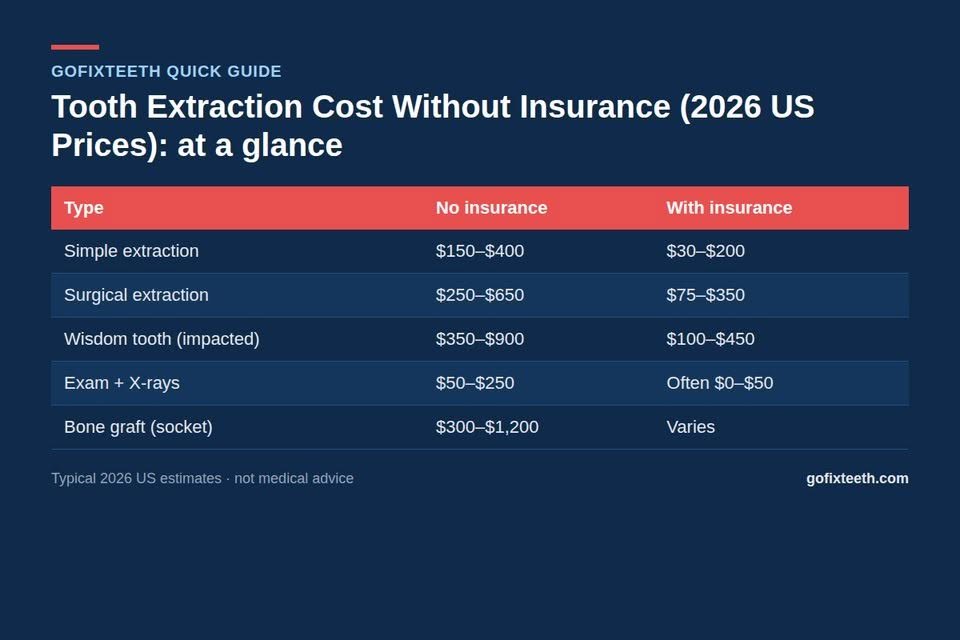
| Type | No insurance | With insurance |
|---|---|---|
| Simple extraction | $150–$400 | $30–$200 |
| Surgical extraction | $250–$650 | $75–$350 |
| Wisdom tooth (impacted) | $350–$900 | $100–$450 |
| Exam + X-rays | $50–$250 | Often $0–$50 |
| Bone graft (socket) | $300–$1,200 | Varies |
Typical 2026 US estimates; they vary by region and insurance. “With insurance” assumes a common plan that pays part of extractions after the deductible. Your share depends on your plan’s percentage, deductible and annual maximum. Oral surgeons usually charge more than general dentists but handle harder cases.
Simple vs surgical vs wisdom tooth extraction
Simple extraction
A simple extraction is for a tooth that is fully visible above the gum and can be loosened and removed with standard instruments after numbing. Front teeth and single-rooted teeth are often in this group. It’s usually a short visit with a general dentist.
Surgical extraction
A surgical extraction is needed when the tooth is broken at the gum line, has curved or multiple roots that need to be sectioned, or requires the gum to be opened or a little bone removed. Many molars, especially ones with large fillings or old root canals, fall into this group. It may be done by a general dentist or an oral surgeon, and stitches are common.
Wisdom teeth
Wisdom tooth prices depend on how they sit. An erupted wisdom tooth may be billed like a simple or surgical extraction. A tooth partly or fully covered by gum or bone (impacted) costs more, and having all four removed with sedation in one visit can run a few thousand dollars total. Our full breakdown is in wisdom teeth removal cost.
Extra costs that are often added
- Exam and X-rays. A focused exam and one or two X-rays are usually needed before an extraction. A 3D (CBCT) scan, used for some wisdom teeth and implant planning, adds roughly $100–$500.
- Sedation. Local numbing is included. Nitrous oxide (laughing gas) often adds about $50–$150, oral sedation about $150–$500, and IV sedation about $200–$800 depending on time. General anesthesia is usually more.
- Bone graft. If you plan an implant later, the dentist may place graft material in the socket to help preserve bone, often $300–$1,200.
- Medications. Prescriptions for pain or, when needed, antibiotics are usually low cost with generic options.
- Follow-up visit. Often included, but ask. Treatment of a dry socket may be extra at some offices.
Typical 2026 US estimates; they vary by region and insurance.
Useful on Amazon for this job
As an Amazon Associate we earn from qualifying purchases. Always confirm fit for your exact vehicle or ask your dentist.
How to avoid surprises on your extraction bill
- “Simple” can become “surgical.” If roots break or bone must be removed, the code changes to a higher fee. Ask whether the X-ray shows curved roots, an old root canal or dense bone.
- Emergency visits: some plans won’t pay for a full exam and an extraction on the same day. A limited (problem-focused) exam may be billed instead.
- Ask about extra line items such as bone smoothing or socket cleaning, which insurers often deny when billed with one extraction.
- Planning an implant or bridge? Ask for a gentle (atraumatic) extraction and whether a socket graft is needed now, which is simpler than rebuilding bone later.
- Upper molars near the sinus need extra care. If liquid comes out of your nose when drinking, avoid blowing your nose and call your dentist.
- Bite on damp gauze for 30 to 45 minutes, avoid hot drinks, smoking and strong rinsing the first day, and start gentle salt-water rinses the next day.
The Dental Recovery & Savings Bundle includes 4 ready-to-use scripts to lower your dental bill, so you know exactly what to say to the front desk about cash prices and payment plans. You also get a printable day-by-day recovery calendar for the days after your extraction, so you know what’s normal while the socket heals. Instant PDF, $12, 30-day money-back promise.
Get the savings scripts →
Does insurance cover tooth extraction?
Most dental plans cover extractions. Many treat simple extractions as a basic service, often paid at around 70% to 80% after the deductible, while surgical extractions may be basic or major depending on the plan. Watch for waiting periods on new plans and your annual maximum.
Medical insurance sometimes pays for extractions connected to certain medical situations, such as before cancer radiation or heart surgery, or after an accident. Original Medicare generally doesn’t cover routine extractions, though some Medicare Advantage plans include dental benefits. Adult Medicaid dental coverage varies by state, but many states cover emergency extractions.
Where to save on a tooth extraction
- Community health centers. Federally funded centers offer sliding-scale fees based on income; search through HRSA (link below).
- Dental schools. Supervised students and residents often charge lower fees.
- Free dental days and clinics. Some events and charities provide free extractions; see free tooth extraction for where to look.
- Ask for the cash price. Many offices offer a discount for paying in full without insurance.
- Dental discount plans. For an annual fee, member offices charge reduced prices. Check participating dentists first.
- Use an FSA or HSA to pay with pre-tax money.
- Skip optional add-ons only after asking. If you don’t plan an implant, ask whether a bone graft is truly needed for you.
One caution: don’t let cost push you toward pulling a tooth that could be saved, or toward delaying an extraction of an infected tooth. Our guide to root canal or pull the tooth compares both choices, and pulling a tooth with an infection explains what to expect when an infected tooth comes out.
Questions to ask before you agree to the price
A two-minute conversation with the front desk can prevent most billing surprises. Before the appointment, ask:
- Is this quoted as a simple or a surgical extraction, and could it change once you start?
- Are the exam and X-rays included, or billed separately?
- What type of numbing or sedation is included in the price?
- Is a bone graft part of the plan, and is it required or optional for me?
- Is the follow-up visit included if I have a problem while healing?
- Do you offer a cash discount or an in-office payment plan?
If you have insurance, ask the office to check your benefits or send a pre-treatment estimate. If you are referred to an oral surgeon, ask for that office’s estimate as well, since its fees and network status may differ from your regular dentist’s.
Plan for what comes after
The extraction cost is only part of the picture if the missing tooth needs replacing. Back teeth at the very end of the mouth sometimes don’t need to be replaced, but front teeth and many molars do, for chewing and to keep neighboring teeth from shifting. Typical replacement options include a flipper or partial denture, a bridge or an implant. Planning that step before the extraction can help, for example by deciding whether a socket graft is worth it.
See a dentist promptly if…
- A tooth is broken, loose or painful to bite on
- You have a swollen gum or a pimple-like bump near a tooth
- After an extraction, pain gets much worse after two to four days (this can be a dry socket)
- Bleeding continues after biting on gauze with firm pressure for 30 to 60 minutes
Seek emergency care right away, or call 911, for facial swelling that is spreading, fever with tooth pain, heavy bleeding that won’t stop, or trouble swallowing or breathing.
Frequently asked questions
How much does it cost to pull a tooth without insurance?
Typically about $150 to $400 for a simple extraction and $250 to $650 for a surgical one in the US in 2026, plus exam and X-rays.
Why is a molar extraction more expensive?
Molars have several roots and thick bone around them, so they more often need a surgical extraction, which takes longer and may need stitches.
Is it cheaper to pull a tooth or get a root canal?
Pulling is cheaper up front, but replacing the tooth later with an implant or bridge often costs more than a root canal and crown.
Does the price include sedation?
Local numbing is usually included. Nitrous oxide, oral sedation and IV sedation are typically extra.
Can I get a tooth pulled for free?
Sometimes, through free clinics, charity events or Medicaid in some states. Community health centers offer reduced fees based on income.
Sources
- MedlinePlus. Tooth Disorders.
- Mayo Clinic. Tooth Abscess: Symptoms and Causes.
- National Institute of Dental and Craniofacial Research. Finding Low-Cost Dental Care.
- HRSA. Find a Health Center.
This article is for general education and does not replace advice from your dentist, who can examine your tooth and give you an exact quote.


