Temporary Tooth Filling: How Long It Lasts and Home Kits
How long a temporary tooth filling lasts, how to care for one, how to use an OTC temporary filling kit safely, and when it’s urgent to see a dentist.
✅ Quick answer
A temporary tooth filling placed by a dentist is meant to last a few weeks, sometimes up to a few months, until the permanent filling, crown or next root canal visit. Over-the-counter temporary filling kits from the drugstore are only a short-term patch for a few days to protect a hole or lost filling until you can get a dental appointment; they don’t treat decay or infection.
Temporary fillings come up in two very different situations. Sometimes your dentist places one on purpose, for example between root canal visits, while a crown is being made, or to calm down an irritated tooth. Other times, a filling falls out on a weekend or while traveling, and you need something to cover the hole until you can be seen.
This guide covers both: how long a dentist’s temporary filling usually lasts and how to care for it, how to use a store-bought kit correctly, the limits of a DIY patch, and the signs that mean you shouldn’t wait.
📩 Important: after you sign up, open the email from Go Fix Teeth and tap Confirm. Your PDF opens right away. Not there? Check Spam or Promotions.
Temporary vs permanent fillings at a glance
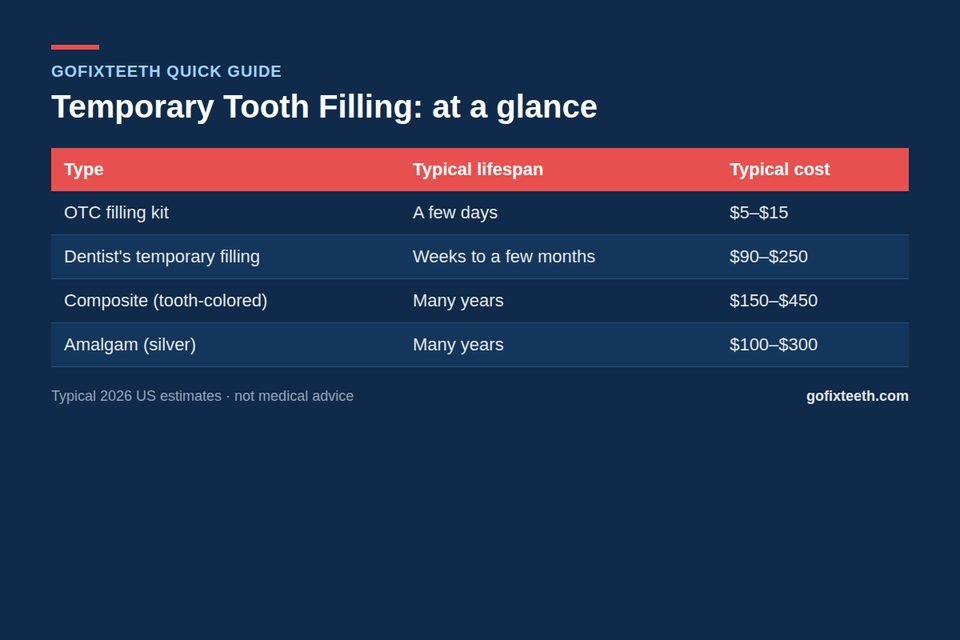
| Type | Typical lifespan | Typical cost |
|---|---|---|
| OTC filling kit | A few days | $5–$15 |
| Dentist’s temporary filling | Weeks to a few months | $90–$250 |
| Composite (tooth-colored) | Many years | $150–$450 |
| Amalgam (silver) | Many years | $100–$300 |
Typical 2026 US estimates; they vary by region and insurance. A temporary filling placed during a root canal or crown appointment is often included in that procedure’s fee. A standalone temporary (sometimes billed as a “palliative” or sedative filling) is usually charged separately.
Why dentists place temporary fillings
- Between root canal visits. The tooth is sealed with a temporary material until the canals are finished. See root canal or pull the tooth for how that decision is made.
- To calm an irritated nerve. A sedative filling, often with a soothing material, may be placed over a deep cavity to see whether the nerve settles before a permanent filling.
- While a crown, inlay or onlay is made. A temporary covers the prepared tooth.
- In an emergency visit, when there’s no time for the full treatment.
Temporary materials are softer than permanent ones so they’re easy to remove later. That’s why they wear down, crack or come out if they’re left too long.
How long a dentist’s temporary filling lasts
Most are designed to last until your next scheduled visit, commonly a few weeks. Some last a few months, but they’re not built for that. Over time, a temporary can:
- Wear down and leave a gap where bacteria can leak in
- Crack or come out in pieces
- Let decay continue underneath, or recontaminate a tooth during root canal treatment
If your dentist placed a temporary, keep the follow-up appointment. Putting off the permanent restoration is one of the most common reasons a tooth that could have been saved ends up needing more treatment.
Caring for a temporary filling
- Wait until the numbness wears off before eating, so you don’t bite your cheek or tongue
- Chew on the other side when you can
- Avoid sticky, hard or chewy foods such as caramel, gum, ice, nuts and crusty bread
- Brush gently around it, and floss by sliding the floss out to the side instead of pulling up
- Expect a little sensitivity for a few days; it should improve, not get worse
It’s normal for a small bit of the surface to wear off. If a large piece comes out, call your dentist.
Useful on Amazon for this job
As an Amazon Associate we earn from qualifying purchases. Always confirm fit for your exact vehicle or ask your dentist.
The Dental Recovery & Savings Bundle includes 4 ready-to-use scripts to lower your dental bill, so you know exactly what to say when you ask about cash discounts or a payment plan for a filling, crown or root canal. You also get a printable day-by-day recovery calendar for after treatment. Instant PDF, $12, 30-day money-back promise.
Get the savings scripts →
Over-the-counter temporary filling kits
Drugstores sell temporary filling materials, usually a putty that hardens after you place it, or a material you mix. They’re meant to cover a lost filling or small hole for a short time until you see a dentist.
How to use one
- Read the package directions, since products differ.
- Clean the area. Brush gently and rinse with warm water. Remove any loose food.
- Dry the tooth as well as you can with a clean cotton ball or gauze.
- Take a small amount and press it into the hole with a clean finger or the tool provided. Don’t overfill.
- Bite down gently to shape it, then remove extra material from the edges and the gumline.
- Wait the time listed on the package before eating or drinking.
Limits of DIY kits
- They don’t remove decay, so a cavity keeps growing underneath
- They don’t treat infection or an inflamed nerve
- They can trap bacteria if the hole wasn’t clean
- They wear away quickly, often within days
- They aren’t a fix for a broken tooth with sharp, deep or bleeding areas
Never use household glue, superglue or nail products in your mouth. If a crown came off rather than a filling, see our guide on glue for a tooth crown for safer temporary options. And if your filling came out without pain, my filling fell out but it doesn’t hurt explains why you should still get it checked.
What happens at the follow-up visit
When you return, the dentist removes the temporary material and checks the tooth. What comes next depends on why the temporary was placed:
- After a sedative filling, if the tooth has calmed down, the dentist may place a permanent filling. If pain has continued or worsened, the nerve may need a root canal.
- During a root canal, the canals are finished and sealed, and the tooth gets a permanent filling. Back teeth often need a crown afterward to protect them from cracking.
- Under a temporary crown, the final crown is checked for fit and bite, then cemented.
- After an emergency patch, the dentist decides whether a filling, crown, root canal or extraction is the right long-term fix.
Ask for a written estimate at this point if more treatment is needed, and ask whether it can be phased over time if cost is a concern.
When it’s urgent
A lost filling with no pain usually needs an appointment within days, not an emergency visit. But some signs mean the tooth needs attention sooner. Call a dentist the same day or next day if:
- You have throbbing pain, pain that wakes you up, or pain when biting
- Sensitivity to hot or cold lingers after the drink is gone
- A large piece of tooth broke off or there’s a sharp edge cutting your tongue
- The gum near the tooth is swollen or has a pimple-like bump
- A temporary placed during a root canal fell out
If cost is the barrier, dental schools and community health centers often charge lower fees. You can search for a federally funded health center through HRSA (link below).
See a dentist promptly if…
- Your temporary filling has been in place longer than your dentist planned
- A DIY patch keeps falling out or the tooth hurts more after placing it
- You notice a bad taste or smell from the tooth
- The tooth looks darker than the teeth around it
Seek emergency care right away, or call 911, for facial swelling that is spreading, fever with tooth pain, or trouble swallowing or breathing. These can be signs of a serious infection.
Frequently asked questions
How long can I keep a temporary filling?
Usually until the next visit, often a few weeks. Leaving it in for months risks leakage, new decay and a lost filling.
Can I eat with a temporary filling?
Yes, once the numbness wears off. Chew on the other side and avoid sticky, hard and chewy foods.
Is it normal for a temporary filling to feel rough or wear down?
Some wear is normal because the material is soft. If a big piece comes out or the tooth hurts, call your dentist.
Do drugstore filling kits work?
They can protect a hole for a few days. They don’t treat decay or infection, so you still need to see a dentist.
What should I do if my temporary filling falls out?
Keep the area clean, avoid chewing on it and call your dentist. An OTC kit can cover it briefly if you can’t get in right away.
Sources
- Cleveland Clinic. Cavities.
- Cleveland Clinic. Root Canal.
- MedlinePlus. Tooth Decay.
- National Institute of Dental and Craniofacial Research. Finding Low-Cost Dental Care.
- HRSA. Find a Health Center.
This article is for general education and does not replace advice from your dentist, who can examine your tooth and recommend the right treatment.