
Glue for a Tooth Crown: Safe Temporary Fix (Not Superglue)
What glue can you use for a tooth crown or cap? Never superglue. How to use temporary dental cement step by step, how long it lasts and recementing cost.
✅ Quick answer
The only “glue” to use for a tooth crown or cap at home is an over-the-counter temporary dental cement sold at drugstores (for example, Dentemp or Recapit-type products), used exactly as the package directs. Never use superglue, Krazy Glue or household adhesives: they are not made for the mouth and can irritate the gums and make it harder for your dentist to refit the crown. A home fix is temporary only, so call your dentist and plan to be seen within a few days.
A crown that pops off usually happens at the worst time: during dinner, on a weekend, or right before a trip. The urge to stick it straight back on is understandable. With the right product and a little care, you can often hold a crown in place for a short time so you can eat and smile normally until your dentist recements it properly.
This guide covers what to use (and what never to use), how to apply temporary dental cement step by step, how long the fix lasts, when a loose crown is urgent, and what recementing usually costs.
📩 Important: after you sign up, open the email from Go Fix Teeth and tap Confirm. Your PDF opens right away. Not there? Check Spam or Promotions.
Why you should never superglue a crown
Superglue (cyanoacrylate) and other household glues seem like a quick fix, but they cause real problems:
- They are not intended for use in the mouth. They can irritate or burn the gums and soft tissue, and the fumes and residue are not something you want near an exposed tooth.
- They can trap bacteria. If decay or food debris is under the crown, gluing it down seals it in.
- They can set the crown in the wrong position. That can change your bite, put stress on the tooth and cause pain.
- They make the dentist’s job harder. Hardened glue must be removed from the crown and tooth, which can damage the crown so it no longer fits, and a new crown costs far more than recementing.
Denture adhesive is also not designed to hold a crown. Stick with a product labeled for re-cementing lost crowns, caps or fillings.
Temporary dental cement options
Drugstores and online retailers sell kits made for this exact situation. They are meant to hold for a short time and to be removed easily by your dentist.
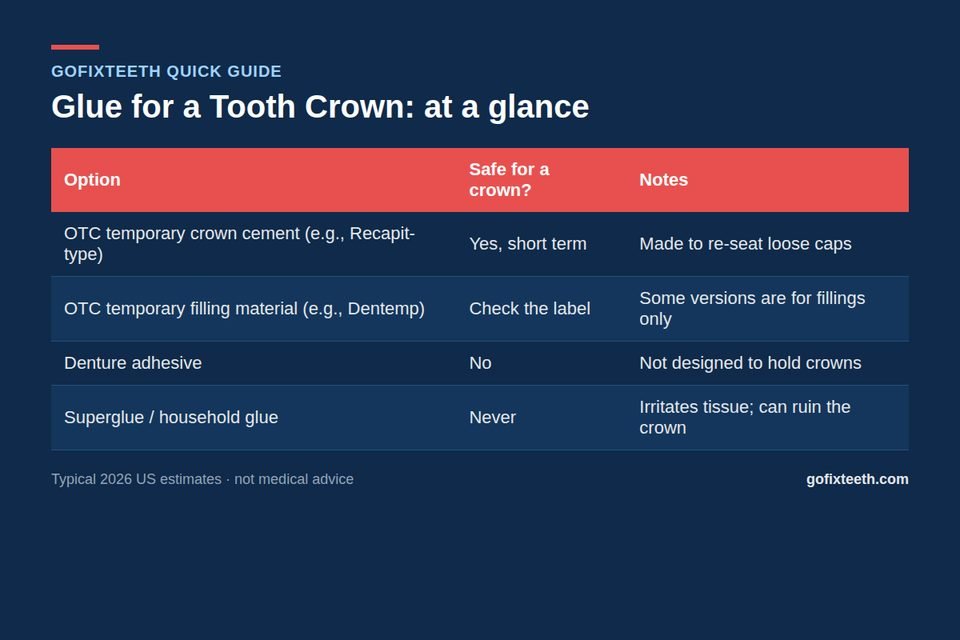
| Option | Safe for a crown? | Notes |
|---|---|---|
| OTC temporary crown cement (e.g., Recapit-type) | Yes, short term | Made to re-seat loose caps |
| OTC temporary filling material (e.g., Dentemp) | Check the label | Some versions are for fillings only |
| Denture adhesive | No | Not designed to hold crowns |
| Superglue / household glue | Never | Irritates tissue; can ruin the crown |
Product lines change, so read the package: it should say it is for re-cementing crowns or caps. Kits typically cost under $15. If you are unsure, call a pharmacist or your dental office and ask which one they suggest.
Before you re-cement: check these first
Do not try to put the crown back on if:
- The crown is cracked or broken into pieces
- A piece of your natural tooth is stuck inside the crown, or the tooth underneath looks broken (see tooth broke off at the gum line)
- The crown does not sit fully down when you test it without cement
- The tooth is very painful, or the gum around it is swollen
- It is a crown on an implant (the screw or abutment may be loose and needs a dentist)
- You think there is a risk of swallowing or inhaling it, such as in a young child or someone who is very drowsy
In those cases, keep the crown in a small bag or container and bring it to your dentist.
Useful on Amazon for this job
As an Amazon Associate we earn from qualifying purchases. Always confirm fit for your exact vehicle or ask your dentist.
The Dental Recovery & Savings Bundle includes 4 scripts to lower your dental bill that you can use when you call to book the recement, plus a printable day-by-day recovery calendar (what’s normal, what to eat, when to call your dentist). Instant PDF, $12, 30-day money-back promise.
Get the savings bundle →
How to use temporary dental cement on a crown
Always follow the instructions on your specific kit. In general, the steps look like this:
- Clean the crown. Gently remove old cement and food from the inside with a toothpick or soft brush. Rinse and pat dry. Do not scrape so hard that you scratch the crown.
- Clean the tooth. Brush the tooth gently, rinse with warm water, and dry it with a piece of gauze or a clean cotton swab.
- Test the fit. Place the crown on the tooth without cement and bite down very gently. It should seat fully and your bite should feel normal. Note which way it faces.
- Apply a thin layer. Mix the cement if your kit requires it, then put a small amount inside the crown, just enough to line it. Too much will stop it from seating and leave a high bite.
- Seat the crown. Push it onto the tooth in the same position, then bite gently on a piece of gauze or cotton for the time the kit specifies.
- Remove the excess. Wipe away extra cement around the edges with a toothpick or cotton swab, and gently floss beside the tooth, pulling the floss out sideways instead of popping it up.
- Check your bite. If the tooth feels high or your teeth don’t close normally, remove it and try again with less cement, or leave it out and call your dentist.
Afterward, avoid eating for the time stated on the package, then chew on the other side. Skip sticky, chewy and hard foods such as caramel, gum and nuts.
How long does a temporary fix last?
OTC cement is designed to be temporary. It may hold for a day or two, or sometimes longer, but it can wash out or loosen at any time. Treat it as a bridge to your dental appointment, ideally within a few days, and not as a permanent repair. Leaving a crown loosely attached for weeks lets bacteria and food leak underneath, which can lead to decay or infection in the tooth below.
If a crown keeps falling off, there is usually a reason, such as decay under the crown, too little tooth left for it to grip, or a broken post. Your dentist needs to find and fix that cause.
If you can’t re-seat the crown
- Keep the crown in a clean, labeled container, and bring it to your appointment
- Cover the exposed tooth with temporary filling material if it is sensitive, if your kit allows
- Avoid very hot, cold and sugary foods and drinks on that side
- Keep brushing gently around the tooth
- Over-the-counter pain relievers can help with mild discomfort; follow the label
A tooth that has had a root canal may feel nothing at all, but it still needs protecting. Our guide on a crown that fell out but doesn’t hurt explains why it still matters.
When a loose crown is urgent
Call your dentist the same day or seek urgent dental care if you have:
- Severe or throbbing pain in the tooth
- Swelling of the gum, face or jaw
- A bad taste, pus or a pimple-like bump on the gum near the tooth
- A broken tooth with sharp edges cutting your tongue or cheek
- A crown or piece of tooth you may have swallowed along with coughing or trouble breathing
Go to an emergency room right away for trouble breathing or swallowing, facial swelling that is spreading toward the eye or neck, or a high fever with tooth pain. If you swallowed a crown and feel fine, it often passes on its own, but call your dentist or doctor for advice.
Cost to recement a crown at the dentist
When the crown and tooth are in good shape, recementing is a quick visit. Typical 2026 US estimates, which vary by region and insurance:
- Recementing a crown: about $100–$300, sometimes less (or included) at the office that placed the crown if it is fairly new
- Exam and X-ray if needed: about $50–$250
- New crown if the old one no longer fits: about $1,000–$2,500
- Root canal if infection is found: about $700–$1,800
Many insurance plans cover recementing at least in part. Bringing the crown, keeping it clean and avoiding glue all improve the odds that the cheaper option is the one you need.
Frequently asked questions
Can I use superglue on a crown just for one day?
No. Even short-term, it can irritate your gums, trap bacteria and damage the crown so it can’t be reused.
What is the best glue for a cap tooth?
An OTC temporary dental cement labeled for crowns or caps. It is a short-term fix until your dentist recements the crown.
How long can I go without my crown?
Try to see a dentist within a few days. The exposed tooth can shift, decay or break the longer it stays uncovered.
Can I put a crown back on without cement?
Not safely. A loose crown can be swallowed or inhaled, especially while sleeping. Keep it in a container instead.
Will my dentist be able to reuse the crown?
Often yes, if it is undamaged, fits well and the tooth underneath is healthy.
Sources
- Cleveland Clinic. Dental Crowns.
- Mayo Clinic. Tooth abscess.
- Mayo Clinic. Cavities/tooth decay.
- MedlinePlus. Dental Health.
This article is for general education and does not replace advice from your dentist, who can examine your tooth and crown.


