Replace Missing Tooth: Implant vs Bridge vs Denture
Ways to replace a missing tooth in 2026: implant, bridge, partial denture or flipper. Costs, lifespan, pros and cons, and what happens if you wait.
✅ Quick answer
The four main ways to replace a missing tooth are a dental implant, a fixed bridge, a removable partial denture, or a flipper (a temporary plastic partial). For one tooth, an implant typically costs about $3,000–$6,000, a three-unit bridge about $2,000–$5,000, a partial denture about $1,000–$3,000, and a flipper about $300–$1,000. Implants usually last the longest, while flippers are meant to be short-term. Typical 2026 US estimates; they vary by region and insurance.
Losing a tooth, whether from decay, an injury or an extraction, leaves you with a choice that affects how you chew, how you smile and what you spend for years to come. There is no single best option for everyone. The right one depends on the health of your gums and jawbone, the teeth next to the gap, your budget and how long you want the result to last.
This guide compares the main ways to replace a missing tooth side by side, explains what each one involves, and covers what can happen if you leave the gap empty.
📩 Important: after you sign up, open the email from Go Fix Teeth and tap Confirm. Your PDF opens right away. Not there? Check Spam or Promotions.
Missing tooth replacement options at a glance
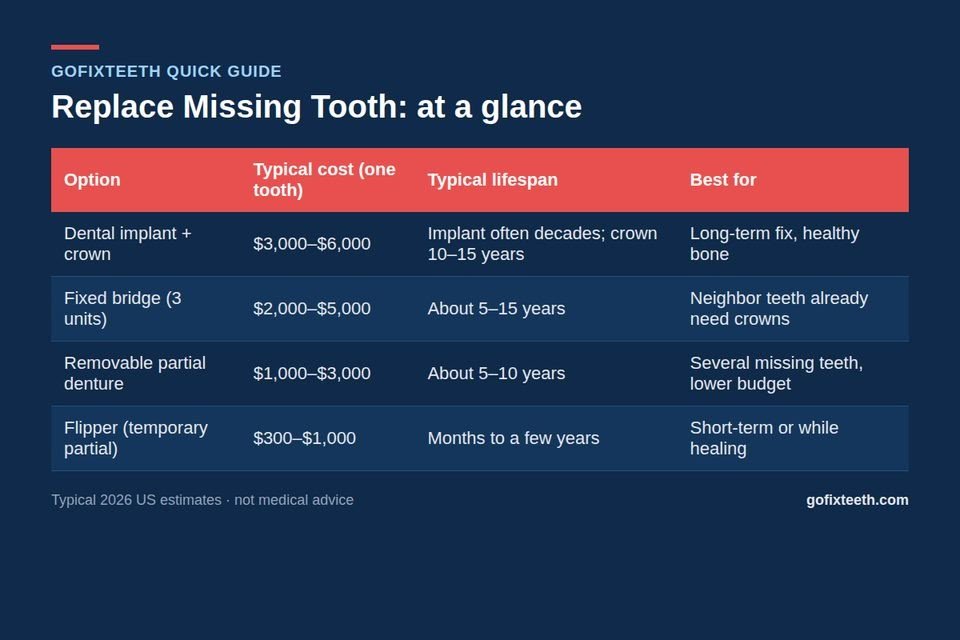
Here is a quick comparison for replacing a single missing tooth, without insurance:
| Option | Typical cost (one tooth) | Typical lifespan | Best for |
|---|---|---|---|
| Dental implant + crown | $3,000–$6,000 | Implant often decades; crown 10–15 years | Long-term fix, healthy bone |
| Fixed bridge (3 units) | $2,000–$5,000 | About 5–15 years | Neighbor teeth already need crowns |
| Removable partial denture | $1,000–$3,000 | About 5–10 years | Several missing teeth, lower budget |
| Flipper (temporary partial) | $300–$1,000 | Months to a few years | Short-term or while healing |
Typical 2026 US estimates; they vary by region and insurance. Implant prices can climb if you need a bone graft, sinus lift or extraction first. Bridge prices depend on how many teeth are involved and the crown material. Lifespans are rough ranges that depend heavily on home care, grinding habits and regular checkups.
How each option works
Dental implant
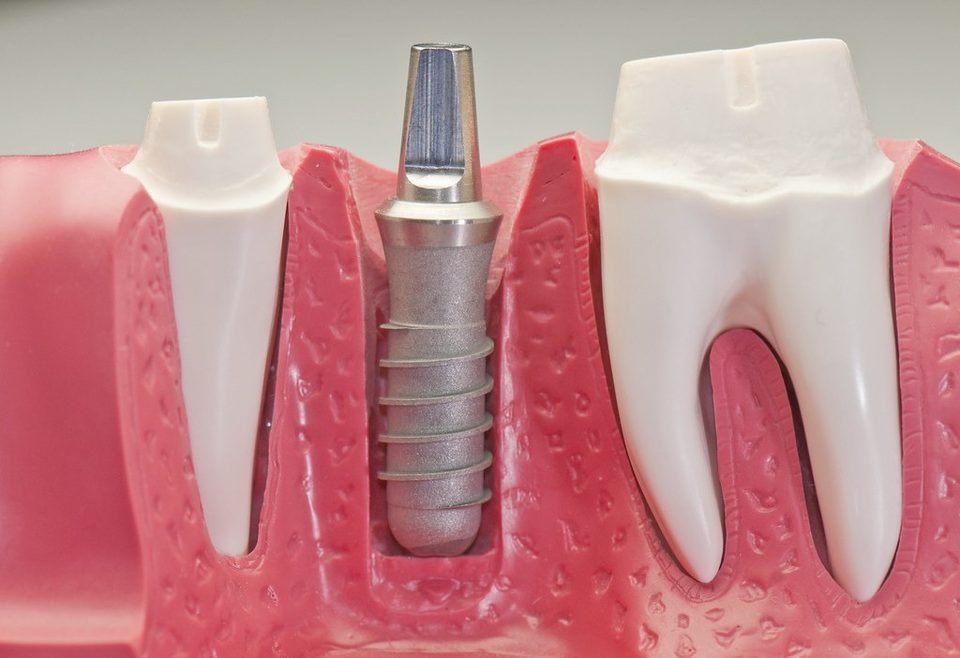
An implant is a small post, usually titanium or zirconia, placed into the jawbone where the root used to be. Over the next few months, the bone bonds to it. Then a connector (abutment) and a crown are attached. Cleveland Clinic describes implants as a long-lasting way to replace a missing tooth that looks and works much like a natural one.
- Pros: does not rely on neighboring teeth, helps keep the jawbone in that area, feels very natural, cleaned like a normal tooth
- Cons: highest upfront cost, minor surgery, several months from start to finish, needs enough healthy bone
Not everyone is a good candidate right away. Uncontrolled diabetes, heavy smoking, active gum disease and some medicines can affect healing, so your dentist or oral surgeon will review your health first. In some cases an implant can be placed on the same day as the extraction; see same-day tooth extraction and implant.
Fixed bridge
A traditional bridge uses the teeth on each side of the gap as anchors. Those teeth are shaped for crowns, and a false tooth (pontic) is attached between them, all in one piece cemented in place.
- Pros: fixed in place, usually done in two visits over a few weeks, no surgery, often well covered by insurance
- Cons: healthy neighboring teeth may need to be filed down, harder to floss under, and if one anchor tooth gets decay the whole bridge may need replacing
A bridge makes the most sense when the teeth next to the gap already have large fillings or crowns. Other designs, such as resin-bonded (Maryland) bridges, remove less tooth but are not right for every spot.
Removable partial denture
A partial denture is a removable appliance with one or more false teeth attached to a gum-colored base, held in place with clasps around your natural teeth. Many are built on a thin metal frame for strength; others are made of flexible plastic.
- Pros: lower cost, can replace several missing teeth in one appliance, no surgery, can often have teeth added later
- Cons: takes time to get used to, can feel bulky, must be removed for cleaning and usually at night, chewing is less efficient than with fixed options
If you want to see how much difference a partial can make to a smile, our before and after partial dentures guide shows what to expect.
Flipper
A flipper is a lightweight acrylic partial, usually with just one or two teeth. It is often made so you are not left with a visible gap while an extraction site or implant heals.
- Pros: least expensive, quick to make, fills a gap for appearance
- Cons: fragile, can feel loose, not meant for heavy chewing, generally a short-term solution
What happens if you don’t replace a missing tooth?
Some people live with a gap, especially at the very back of the mouth, and a dentist may agree that it is acceptable in certain cases. But leaving a space empty can lead to changes over time:
- Teeth can drift. Neighboring teeth may tip into the space, and the opposite tooth can grow down (over-erupt) because it has nothing to bite against. This can change your bite and make future replacement harder.
- Bone can shrink. Without a root to stimulate it, the jawbone in that area tends to shrink, which can make an implant more complex later.
- Chewing gets harder. You may chew on one side, putting more load on the remaining teeth.
- Cleaning gets harder. Tipped teeth create new spots where food and plaque collect, raising the risk of decay and gum disease.
- Appearance and speech. A front gap can affect how you speak and how comfortable you feel smiling.
These changes usually happen gradually, which is why it is worth asking your dentist how long you can safely wait if you need time to save up.
Useful on Amazon for this job
As an Amazon Associate we earn from qualifying purchases. Always confirm fit for your exact vehicle or ask your dentist.
The Dental Recovery & Savings Bundle includes 4 ready-to-use scripts to lower your dental bill, so you know exactly what to ask about pricing, payment plans and phasing treatment before you sign. You also get a printable day-by-day recovery calendar for after extractions and implant surgery. Instant PDF, $12, 30-day money-back promise.
Get the savings scripts →
How to choose the right option
Your dentist will look at your mouth, take X-rays and possibly a 3D scan before recommending anything. These questions can help you think it through together:
- How healthy are the teeth next to the gap? If they are healthy and untouched, an implant avoids drilling them for a bridge. If they already need crowns, a bridge can solve two problems at once.
- Do you have enough bone and healthy gums? Gum disease usually needs treatment first, and bone loss may mean grafting before an implant.
- How many teeth are missing? Several gaps in one arch may be handled more affordably with a single partial denture.
- What is your budget and timeline? Implants cost more upfront but may need fewer replacements over many years. A flipper can bridge the time while you save.
- What does your insurance cover? Plans vary. Many cover bridges and dentures as major services at around 50%, while implant coverage is less consistent. Annual maximums often limit how much the plan pays.
If you are paying out of pocket, dental schools and community health centers can sometimes offer lower fees, and asking for a written, itemized estimate makes it easier to compare offices. For broader context on dental costs without insurance, see how much a dental cleaning costs without insurance.
See a dentist promptly if…
- A tooth was just knocked out (see a dentist right away; quick action can sometimes save it)
- The gap or the gum around it is painful, swollen or bleeding
- A bridge, partial or flipper is loose, cracked or rubbing a sore spot
- Neighboring teeth feel loose or your bite has changed
Seek emergency care right away, or call 911, for facial swelling that is spreading, fever with mouth pain, uncontrolled bleeding, or trouble swallowing or breathing.
Frequently asked questions
What is the cheapest way to replace a missing tooth?
A flipper is usually the least expensive, followed by a removable partial denture. Both cost less upfront than a bridge or implant but tend to need replacing sooner.
Is an implant better than a bridge?
Not always. An implant avoids reshaping neighboring teeth and can last a very long time, but a bridge may be a good choice if those teeth already need crowns or if an implant is not possible.
How long can I wait to replace a missing tooth?
It depends on the location and your mouth. Bone and teeth can shift over months to years, so ask your dentist how long waiting is reasonable in your case.
Does insurance pay to replace a missing tooth?
Many plans help with bridges and dentures. Implant coverage varies a lot. Ask for a pre-treatment estimate so you know your share before you start.
Can a flipper be permanent?
Flippers are generally designed as temporary teeth. Using one long-term can be hard on the gums and remaining teeth, so ask your dentist about a longer-lasting option.
Sources
- Cleveland Clinic. Dental Implants.
- American Dental Association, MouthHealthy. Implants.
- Cleveland Clinic. Dental Crowns.
- National Institute of Dental and Craniofacial Research. Finding Low-Cost Dental Care.
- MedlinePlus. Dental Health.
This article is for general education and does not replace advice from your dentist, who can examine your mouth and recommend the best option for you.