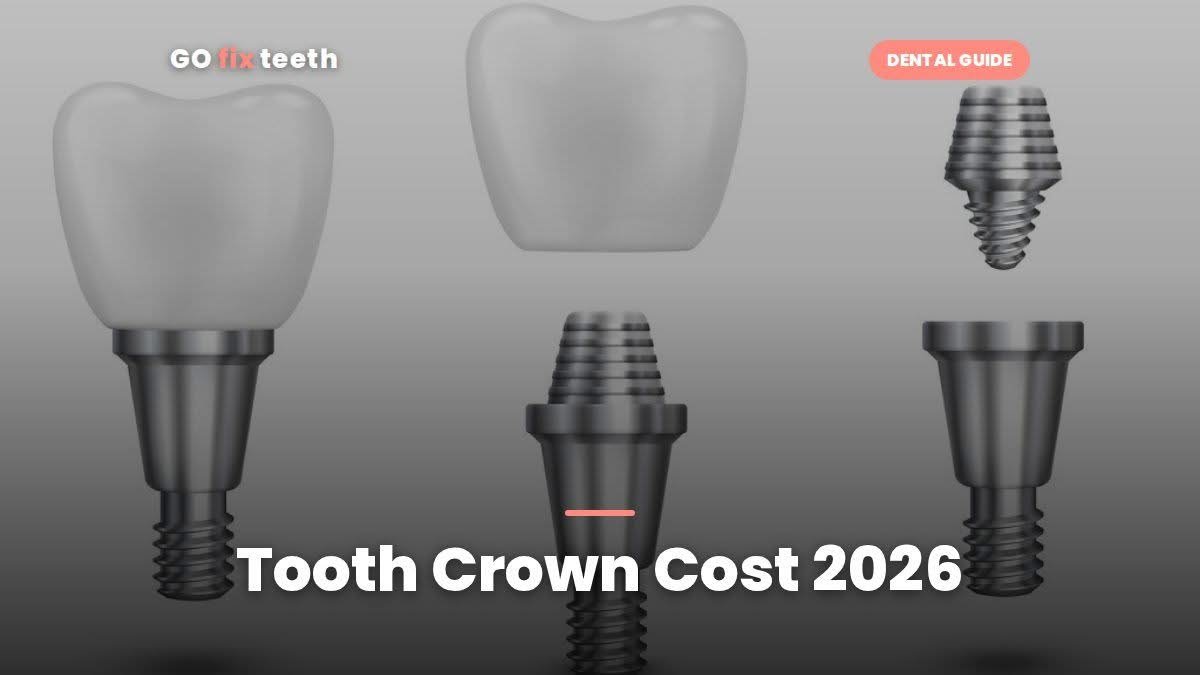
Tooth Crown Cost 2026: Prices by Material (US Guide)
Tooth crown price in 2026: porcelain, zirconia, PFM, gold and same-day crowns, with and without insurance, hidden extra costs and real ways to save.
Reviewed on October 30, 2026 · How medical review works
Disclosure: This post contains affiliate links. If you buy through them, we may earn a small commission at no extra cost to you.
✅ Quick answer
A tooth crown typically costs about $1,000 to $2,500 per tooth without insurance in the US in 2026, depending on the material and where you live. A porcelain tooth crown (all-ceramic or e.max) usually runs about $1,000–$2,500, porcelain-fused-to-metal about $900–$1,500, and zirconia about $1,000–$2,500.
With dental insurance that covers crowns at 50%, many people pay roughly $500–$1,250 out of pocket, before extras like a build-up or root canal. Typical 2026 US estimates; they vary by region and insurance.
Few dental bills surprise people like a crown. You go in for a cracked or heavily filled tooth, and the estimate comes back with four figures and a few line items you have never heard of. Knowing the usual tooth crown price range before you sit in the chair makes it much easier to ask the right questions and spot a fair quote.
This guide breaks down tooth crown cost by material, what insurance usually pays, the extra charges that often get added, and the practical ways to bring the total down without cutting corners on your tooth.
📩 Important: after you sign up, open the email from Go Fix Teeth and tap Confirm. Your PDF opens right away. Not there? Check Spam or Promotions.
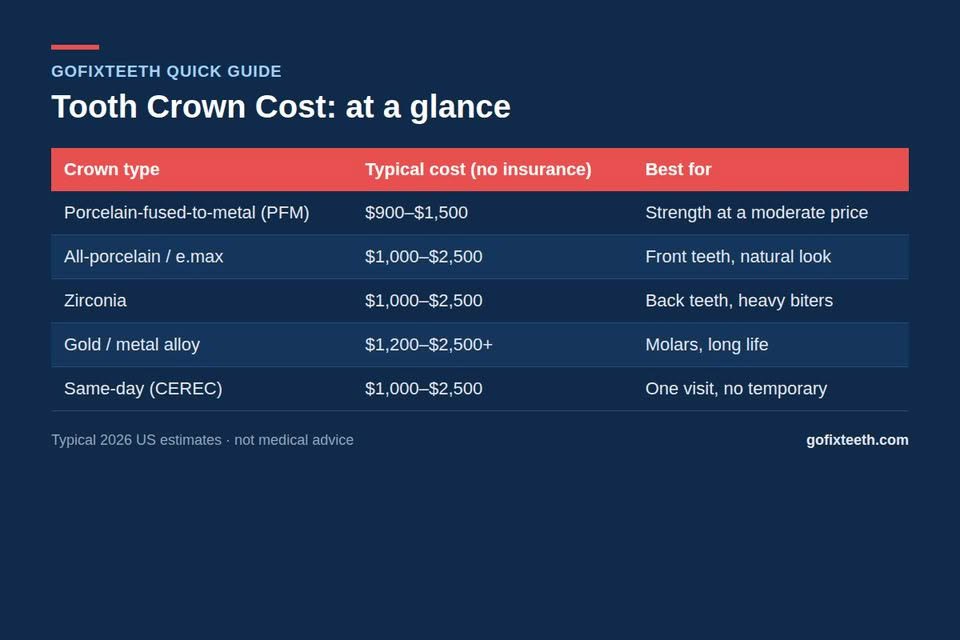
Tooth crown price by material (2026)
The material is the biggest single factor in what you pay. Here are typical ranges for one crown on a permanent tooth, without insurance:
| Crown type | Typical cost (no insurance) | Best for |
|---|---|---|
| Porcelain-fused-to-metal (PFM) | $900–$1,500 | Strength at a moderate price |
| All-porcelain / e.max | $1,000–$2,500 | Front teeth, natural look |
| Zirconia | $1,000–$2,500 | Back teeth, heavy biters |
| Gold / metal alloy | $1,200–$2,500+ | Molars, long life |
| Same-day (CEREC) | $1,000–$2,500 | One visit, no temporary |
Typical 2026 US estimates; they vary by region and insurance. Prices in large coastal cities often sit at the top of these ranges, while smaller towns and the Midwest are often lower. The price of gold also moves the cost of metal crowns up or down.
What you get with each crown type
Porcelain-fused-to-metal (PFM)
PFM crowns have a metal base covered with tooth-colored porcelain. They have been used for decades and are strong enough for back teeth. The downsides: a thin dark line can show at the gumline over time, and the porcelain layer can chip.
Porcelain tooth crown (all-ceramic or e.max)
An all-porcelain crown has no metal, so light passes through it more like natural enamel. That is why dentists often choose it for front teeth. Lithium disilicate (often sold under the brand name e.max) is a common choice: it looks very natural and is reasonably strong, though a dentist may prefer something tougher for a back tooth in someone who grinds.
Zirconia
Zirconia is a very strong ceramic. Solid (monolithic) zirconia is a popular choice for molars because it resists cracking, while layered zirconia looks more natural but costs more. Many offices price zirconia and e.max the same.
Gold and metal alloy
Gold crowns are durable, gentle on the opposing teeth, and need less tooth removed. They are rarely chosen for visible teeth because of the color, but many dentists still consider them an excellent option for back molars.
Same-day CEREC crowns
With same-day (CAD/CAM) crowns, the office scans your tooth and mills a ceramic crown in the office, usually in one long visit. You skip the temporary crown and the second appointment. The price is often similar to a lab-made ceramic crown, though some offices charge a little more.
Tooth crown cost with and without insurance
Most dental insurance plans list crowns as a “major” service. A common setup looks like this:
- Coverage of about 50% after your deductible, when the crown is needed for a health reason (not purely cosmetic)
- An annual maximum, often in the range of $1,000 to $2,000, which a single crown plus a root canal can use up
- Waiting periods on new plans, sometimes 6 to 12 months for major work
- Replacement limits, often one crown per tooth every 5 years or so
- Material downgrades: some plans pay only the PFM or metal rate on back teeth, and you pay the difference for porcelain or zirconia
So on a $1,300 crown with 50% coverage and a deductible already met, you might pay around $650. Without insurance, you pay the office’s full fee unless you use a discount plan, payment plan or school clinic. Always ask the office for a written estimate, and ask them to send a pre-treatment estimate (pre-determination) to your insurer so you know your share before work starts.
Medicare Part A and Part B generally do not cover routine dental work like crowns, though some Medicare Advantage plans include dental benefits. Medicaid dental coverage for adults varies a lot by state.
Useful on Amazon for this job
- Water flosser (great for crowns)
- Floss threaders for crowns and bridges
- Night guard for teeth grinding
As an Amazon Associate we earn from qualifying purchases. Always follow the product instructions and ask your dentist if you are unsure.
Facing a crown or root canal?
The Dental Recovery & Savings Bundle ($12) includes a 16-procedure US price table with typical PPO out-of-pocket costs, word-for-word scripts for asking your dental office about the cash price and payment options, and the full pre-treatment question checklist. 30-day money-back guarantee.
Billing details that change what you actually pay
- Core buildup fees. If a large filling or break leaves too little tooth, a buildup (CDT D2950) is placed first. Insurers sometimes deny it as “included” unless X-rays or photos show it was needed, so ask the office to send documentation.
- The molar “downgrade” clause. Many PPO plans pay a back-tooth crown as if it were an all-metal crown, even when you get zirconia or porcelain. You may owe the difference on top of your normal coinsurance. Ask whether your plan has an alternate benefit provision.
- Replacement frequency limits. Most plans won’t pay for a new crown on the same tooth within a set period, often five years or more. Check before replacing a crown that is still fairly new.
- Prep date vs. seat date. Plans differ on whether the claim counts on the day the tooth is prepared or the day the crown is cemented. If your treatment crosses into a new year, ask which date your plan uses so you don’t waste remaining benefits.
- Lab or “upgrade” fees. Ask whether the quote includes any extra lab charges beyond your copay. Many in-network contracts limit these, but rules vary.
- Material for the spot. Solid (monolithic) zirconia is very durable for molars, especially if you grind; e.max (lithium disilicate) is popular for front teeth because it looks more natural.
- Deep decay can add a procedure. If the damage reaches far below the gum, crown lengthening surgery (D4249) may be needed so the crown has healthy tooth to sit on.
- Ask whether an onlay would do. For a tooth that only needs a cusp protected, a bonded onlay can save more natural tooth than a full crown.
The Dental Recovery & Savings Bundle includes 4 ready-to-use scripts to lower your dental bill, so you know exactly what to say to the front desk before you agree to the price. You also get a printable day-by-day recovery calendar for after the procedure. Instant PDF, $12, 30-day money-back promise.
Get the savings scripts →
Extra costs that can come with a crown
The crown fee itself is often not the whole bill. Ask whether your estimate includes any of these:
| Add-on | When it’s needed | Typical cost |
|---|---|---|
| Exam and X-rays | New patient or new problem | $50–$250 |
| Core build-up | Not enough tooth left to hold the crown | $150–$400 |
| Post and core | After some root canals | $250–$500 |
| Root canal | Infected or dying nerve | $700–$1,800 (molars highest) |
| Crown lengthening | Break or decay below the gumline | $500–$1,500 |
Typical 2026 US estimates; they vary by region and insurance. The temporary crown is usually included in the crown fee. If the tooth has decay or a break near the gum, like the situations in our guide to a tooth that broke off at the gum line, extra steps are more likely. And if you are worried about the nerve treatment part, see does a root canal hurt.
How to save on a tooth crown
- Dental schools. Students treat patients under faculty supervision, often for noticeably lower fees. Visits take longer and you may wait for an opening. The National Institute of Dental and Craniofacial Research lists dental schools and other low-cost options.
- Community health centers. Federally funded centers often charge on a sliding scale based on income.
- Dental discount (savings) plans. For an annual fee, member offices agree to reduced prices, often a meaningful percentage off crowns. These are not insurance; check that your dentist participates and read the fee schedule.
- Ask for a cash or prepayment discount. Many private offices offer a reduction for paying in full without insurance. It never hurts to ask.
- Payment plans and medical credit. In-office plans or healthcare credit cards can spread the cost. Read the terms carefully: some promotional plans charge all the deferred interest if the balance isn’t paid off on time.
- Time your treatment. If you have insurance and need several crowns, splitting them across two benefit years can use two annual maximums. Only do this if your dentist says waiting is safe.
- Get a second opinion. If a big treatment plan arrives, another exam can confirm the need and compare fees.
- Use your FSA or HSA. Crowns are generally an eligible expense, which means paying with pre-tax money.
One thing not to skimp on: the crown itself. Very cheap crowns with a poor fit can leak and let decay start underneath, which can cost far more later.
Is a crown worth the cost?
A crown protects a tooth that is cracked, weakened by a large filling, worn down, or treated with a root canal (especially back teeth). With good care, many crowns last 10 to 15 years or longer.
Cheaper alternatives exist in some cases, such as a large filling or an onlay, but a dentist has to decide whether the tooth can safely hold one. If a crown is recommended and you delay it, a cracked tooth can split further, and sometimes the only option left is extraction and an implant, which costs much more.
See a dentist promptly if…
- You have a cracked tooth that hurts when you bite or release
- A tooth has lingering pain to hot or cold, or throbs on its own
- Your gum near the tooth is swollen or has a pimple-like bump
- A crown or filling has come off (see crown fell out but it doesn’t hurt)
Seek emergency care right away for facial swelling that is spreading, fever with tooth pain, or trouble swallowing or breathing. These can be signs of a serious infection.
Products worth a look while you wait for a dentist
These are options people commonly ask about alongside the advice in this article. We have not tested these products; the details below come from the listings and brands, and ratings and availability change often.
DenTek Temparin Max Advanced Tooth Repair Kit
Marketed as a temporary at-home fix for a lost filling, cap or crown until you can see a dentist. It is not a permanent repair and does not treat the cause, so book an appointment. The listing shows about 4.3 stars from roughly 3,100 ratings.
Sensodyne Repair and Protect Whitening Toothpaste (pack of 4)
Marketed for sensitive teeth; the brand says it builds a protective layer over exposed areas. It shows about 4.8 stars from roughly 13,500 ratings. Lasting or worsening tooth pain needs a dentist, not just a toothpaste.
GUM Proxabrush Go-Betweens Tight Interdental Brushes (15 count)
Small interdental brushes for cleaning between teeth and around dental work. Pick a size that slides in without force; your hygienist can show you which one. It shows about 4.7 stars from roughly 9,700 ratings.
If you want to step up (higher-priced options)
Upgrade note: the ADA says neither electric nor manual toothbrushes are clearly better for cleaning, and the right choice depends on what you will use consistently. These are options for people who want a step up, not a requirement. Ask your dentist what suits your mouth.
Oral-B iO5 Rechargeable Electric Toothbrush (with 3 brush heads and travel case)
A premium-priced rechargeable brush; the listing describes five cleaning modes and a visual pressure sensor meant to help you avoid brushing too hard. It shows about 4.4 stars from roughly 4,500 ratings.
Waterpik Aquarius Countertop Water Flosser (10 settings, 7 tips)
A countertop water flosser with adjustable pressure, often used around braces, implants and bridges. It shows about 4.6 stars from a very large base of roughly 158,600 ratings.
Philips Sonicare DiamondClean 9000 Electric Toothbrush Bundle
A higher-end Sonicare model sold as a bundle. It shows about 4.5 stars, though on a smaller base of roughly 400 ratings, so read recent reviews before you buy.
Frequently asked questions
How much is a porcelain tooth crown without insurance?
Typically about $1,000 to $2,500 per tooth in the US in 2026, depending on the city, the office and the type of ceramic.
Why do crowns cost so much?
The fee covers two visits (or in-office milling equipment), lab work, materials, the temporary crown and the dentist’s time adjusting the fit and bite.
Is a zirconia crown more expensive than porcelain?
Often they are priced about the same. Layered zirconia for front teeth can cost more than solid zirconia used on molars.
Does insurance cover a crown?
Most plans cover a needed crown at around 50% after the deductible, up to the annual maximum. Purely cosmetic crowns usually aren’t covered.
Are same-day crowns cheaper?
Not usually. They are often similar in price to lab-made crowns but save a second visit and the temporary crown.
Sources
- Cleveland Clinic. Dental Crowns.
- Cleveland Clinic. Root Canal.
- National Institute of Dental and Craniofacial Research. Finding Low-Cost Dental Care.
- MedlinePlus. Dental Health.
This article is for general education and does not replace advice from your dentist, who can examine your tooth and give you an exact quote.