Tooth Decay Smell: Why Rotting Teeth Smell and What to Do
Why does tooth decay smell? Causes of a smelly tooth, from cavities to food under a crown, gum disease and abscess, plus home checks and treatment costs.
✅ Quick answer
Tooth decay smells because bacteria living in the cavity break down food and tooth material and release foul-smelling sulfur gases, and the hole traps food that brushing can’t reach. A smelly tooth can also come from food stuck under a crown or filling, gum disease, an abscess or a dry socket. Brushing won’t fix a cavity, so see a dentist; seek urgent care if the smell comes with swelling, fever or pus.
Noticing a bad smell or taste coming from one tooth is unsettling, and many people feel embarrassed to bring it up. It is a common reason people book a dental visit, and it is useful information: a smell that seems to come from one spot often points to a specific problem a dentist can find and treat.
Below we explain why tooth decay odor happens, why smelly tooth decay tends to get worse over time, the other common causes of a smelly tooth, simple checks you can do at home, and what treatment usually involves and costs.
📩 Important: after you sign up, open the email from Go Fix Teeth and tap Confirm. Your PDF opens right away. Not there? Check Spam or Promotions.
Why does tooth decay smell?
Your mouth naturally contains many kinds of bacteria. When decay creates a cavity, it becomes a protected pocket where bacteria and food debris collect. As the bacteria break down proteins from food and damaged tooth tissue, they release volatile sulfur compounds, the same type of gases behind most bad breath. The result is often described as a rotten or “dead” smell.

Several things make a decayed tooth smell worse:
- Trapped food. A hole or a broken edge catches food every time you eat, and a toothbrush often can’t clean it out.
- Deeper decay. As decay reaches the inner layers and the pulp (nerve) inside the tooth, tissue can break down and the smell can become stronger.
- Infection. If bacteria cause an abscess, pus can drain into the mouth and leave a foul taste.
- Dry mouth. Saliva helps wash away bacteria. Less saliva, from mouth breathing, some medicines or not drinking enough, lets odors build up.
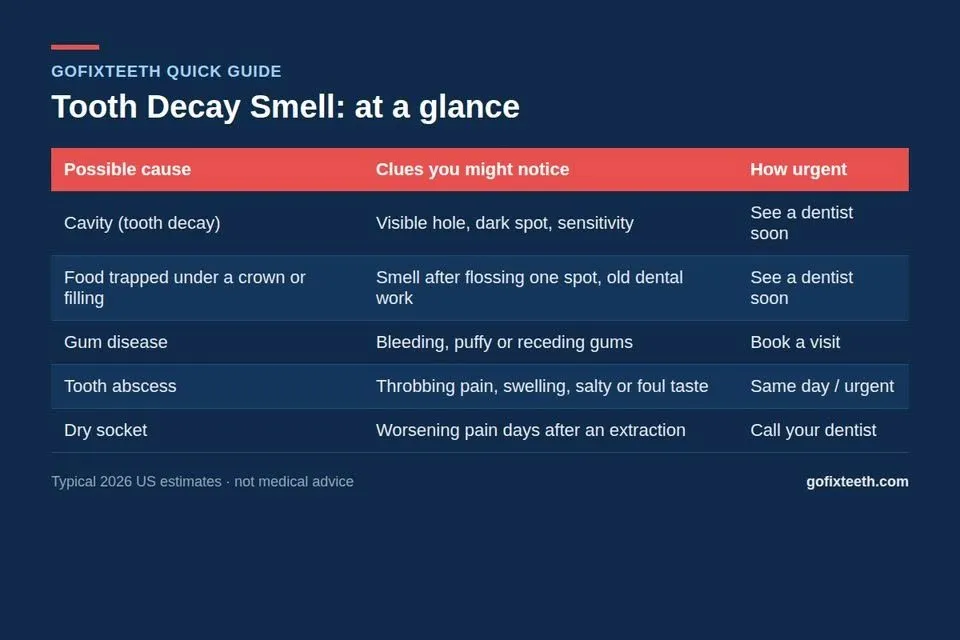
Common causes of a smelly tooth
Decay is only one possibility. A dentist sorts these out with an exam and often X-rays.
| Possible cause | Clues you might notice | How urgent |
|---|---|---|
| Cavity (tooth decay) | Visible hole, dark spot, sensitivity | See a dentist soon |
| Food trapped under a crown or filling | Smell after flossing one spot, old dental work | See a dentist soon |
| Gum disease | Bleeding, puffy or receding gums | Book a visit |
| Tooth abscess | Throbbing pain, swelling, salty or foul taste | Same day / urgent |
| Dry socket | Worsening pain days after an extraction | Call your dentist |
Decay at the gumline or under old dental work
Decay often starts in places that are hard to see: between teeth, at the gumline, or at the edge of an old filling or crown. A small gap at the margin of a crown lets food and bacteria slip underneath, and decay can grow out of sight. People often notice the smell on their floss before they notice any pain. Our guide to tooth decay at the gum line shows what this can look like.
Gum disease
In gum disease, plaque and tartar build up along and below the gumline and create pockets between the gum and tooth. These pockets hold bacteria that produce a strong odor. Bleeding when you brush, red or swollen gums, and gums pulling back from the teeth are typical signs. Early gum disease (gingivitis) can often be reversed with a professional cleaning and better daily care.
Tooth abscess
An abscess is a pocket of pus caused by a bacterial infection, either at the tip of the root or in the gum. It can cause a foul taste, a bad smell, throbbing pain, and sometimes a pimple-like bump on the gum that leaks. An abscess does not go away on its own and can spread, so it needs prompt dental care.
Dry socket after an extraction
After a tooth is pulled, a blood clot should fill the socket. If it is lost too early, the bone underneath is exposed, which can cause intense pain and a bad smell or taste a few days after the extraction. Normal healing can also look white or yellowish; our article on white stuff in a healing extraction site explains the difference.
Other sources of bad breath
Not every bad smell comes from a tooth. Coating on the back of the tongue, tonsil stones, sinus problems, dry mouth, smoking, strong foods and some medical conditions can all cause bad breath. If a dentist finds no dental cause, they may suggest seeing your doctor.
Simple checks you can do at home
These won’t diagnose the problem, but they can help you describe it to your dentist:
- Floss and smell. Floss each space gently and smell the floss. A strong odor from one particular gap points to that area.
- Look with a light. Use a mirror and phone flashlight to check for holes, dark or brown spots, broken edges, or a gap at the edge of a crown. For what dark spots can mean, see black tooth.
- Check your gums. Notice bleeding, swelling, a bump, or gum pulling back from one tooth.
- Notice the taste. A constant salty, metallic or foul taste in one spot can point to drainage from an infection.
- Clean your tongue. Gently brush or scrape your tongue for a few days. If the smell improves a lot, the tongue may be a big part of it.
Do not poke into a hole with sharp objects or try to drain a gum bump yourself.
Useful on Amazon for this job
As an Amazon Associate we earn from qualifying purchases. Always confirm fit for your exact vehicle or ask your dentist.
The Dental Recovery & Savings Bundle includes 4 scripts to lower your dental bill, so you know what to ask before you agree to treatment, plus a printable day-by-day recovery calendar (what’s normal, what to eat, when to call your dentist). Instant PDF, $12, 30-day money-back promise.
Get the savings bundle →
What helps until your appointment
- Brush twice a day with fluoride toothpaste, paying gentle attention to the problem tooth
- Clean between your teeth once a day with floss or interdental brushes
- Rinse with water after meals, or with a warm salt-water rinse
- Drink plenty of water and limit sugary snacks and drinks
- An alcohol-free antibacterial mouthwash may mask odor briefly, but it does not treat decay or infection
If the smell goes away for a while, the cause is usually still there. Decay does not heal on its own once it has formed a cavity.
Treatment and typical costs
Treatment depends on what the dentist finds. Typical 2026 US estimates, which vary by region and insurance:
- Exam and X-rays: about $50–$250
- Filling for a cavity: about $100–$300 (silver amalgam) or $150–$450 (tooth-colored)
- Professional cleaning: about $100–$200; deep cleaning for gum disease often $150–$400 per quarter of the mouth (see dental cleaning cost without insurance)
- Root canal for an infected tooth: about $700–$1,800, often followed by a crown at $1,000–$2,500
- Replacing a leaking crown or filling: similar to the costs above
- Extraction: about $150–$400 for a simple extraction, more for surgical
- Dry socket care: often included by the office that did the extraction, or a short visit fee
If an abscess is present, the dentist treats the source, by root canal or extraction, and may prescribe antibiotics if the infection is spreading. Antibiotics alone don’t fix the tooth. If you’re nervous about the procedure, see does a root canal hurt.
See a dentist or seek emergency care if…
Book a dental visit soon for any smell or bad taste from one tooth that doesn’t go away with good brushing and flossing over a few days.
Call your dentist the same day or seek urgent dental care if you have:
- Throbbing tooth pain or pain when biting
- A swollen gum or a pimple-like bump that leaks
- Pain that gets worse a few days after an extraction
- Fever over 100.4°F (38°C) with tooth pain
Go to an emergency room right away for swelling of the face, jaw or neck that is spreading, swelling near the eye, trouble swallowing or breathing, or feeling very unwell with fever. A dental infection can spread and become serious.
Frequently asked questions
What does tooth decay smell like?
Many people describe it as rotten, sour or like spoiled food. The smell comes from sulfur gases made by bacteria in the cavity.
Can a cavity cause bad breath even if it doesn’t hurt?
Yes. Decay often causes no pain early on, but trapped food and bacteria can still produce a noticeable odor.
Why does my crown smell when I floss?
Food or bacteria may be getting under the edge of the crown, or there may be decay or gum disease there. A dentist should check it.
Will mouthwash get rid of a tooth decay smell?
Only briefly. Mouthwash can mask the odor, but the cavity or infection needs dental treatment.
Is a smelly tooth an emergency?
Not by itself, but it is if it comes with facial swelling, fever, pus or trouble swallowing or breathing.
Sources
- Mayo Clinic. Bad breath.
- Mayo Clinic. Cavities/tooth decay.
- Mayo Clinic. Tooth abscess.
- Cleveland Clinic. Dry Socket.
- MedlinePlus. Tooth Decay.
This article is for general education and does not replace advice from your dentist, who can examine your mouth and find the cause.