Permanent Dentures: Types, Cost & Who Qualifies (2026)
Permanent dentures explained: fixed All-on-4 style vs snap-on implant overdentures, typical 2026 US cost per arch, who is a good candidate, and care.
✅ Quick answer
“Permanent dentures” usually means a full arch of teeth fixed to dental implants (often called All-on-4 or All-on-6) that only a dentist can remove. They typically cost about $15,000 to $30,000 per arch without insurance. A cheaper middle option is a snap-on implant overdenture, which clips onto 2 to 4 implants but still comes out for cleaning, often about $6,000 to $15,000 per arch. Typical 2026 US estimates; they vary by region and insurance.
If you wear regular dentures and are tired of them slipping, or you are about to lose most of your teeth, permanent dentures can sound like the ideal fix. They feel much closer to natural teeth, don’t need adhesive, and stay put when you laugh or eat.
They also cost a lot and need surgery. This guide explains the two main types of implant dentures, what they usually cost in 2026, who is a good candidate, and what to ask before you sign a treatment plan.
📩 Important: after you sign up, open the email from Go Fix Teeth and tap Confirm. Your PDF opens right away. Not there? Check Spam or Promotions.
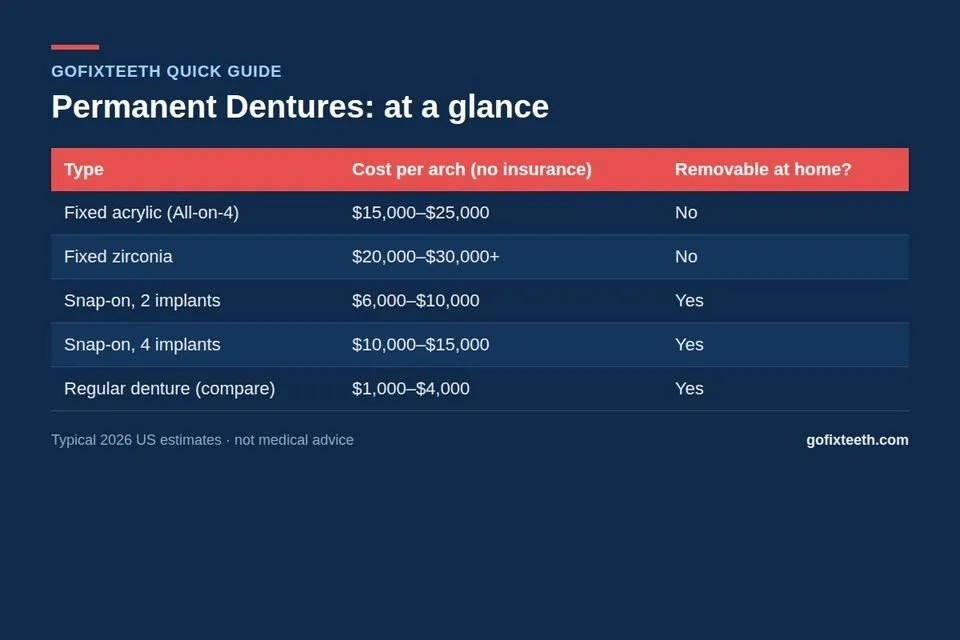
Permanent dentures cost by type (2026)
| Type | Cost per arch (no insurance) | Removable at home? |
|---|---|---|
| Fixed acrylic (All-on-4) | $15,000–$25,000 | No |
| Fixed zirconia | $20,000–$30,000+ | No |
| Snap-on, 2 implants | $6,000–$10,000 | Yes |
| Snap-on, 4 implants | $10,000–$15,000 | Yes |
| Regular denture (compare) | $1,000–$4,000 | Yes |
Typical 2026 US estimates; they vary by region and insurance. Quotes often differ in what they include. Some cover extractions, a temporary fixed set, CT scans and sedation; others list them separately. Bone grafting and sinus lifts, when needed, add more.
Fixed implant dentures (All-on-4 style)
With a fixed implant denture, a full arch of teeth is screwed onto several implants in the jaw, often four to six. The name “All-on-4” refers to a technique that uses four implants, with the back two angled to make better use of the available bone. Many brands and offices use their own names for similar treatments.
Often the remaining teeth are removed, the implants are placed, and a temporary fixed set of teeth is attached the same day or within days. After a few months of healing, the final bridge is made. Only a dentist can unscrew it, usually for cleanings or repairs.
Pros
- Feels and works most like natural teeth
- No adhesive, no taking teeth out at night
- Upper versions usually don’t cover the palate, so food tastes more normal
- Implants help preserve the jawbone where they are placed
Cons
- Highest cost
- Requires surgery and enough bone (or grafting)
- Harder to clean underneath; you need special brushes or a water flosser
- Repairs, like a chipped acrylic tooth or a replacement bridge, can be costly
Acrylic vs zirconia bridge
The final teeth are often acrylic over a metal bar, or solid zirconia. Acrylic is cheaper and easier to repair but wears and stains over time. Zirconia is very strong and stain-resistant but costs more and is harder to fix if it chips. Ask your dentist which one they recommend for your bite.
Snap-on implant overdentures
A snap-on (implant-retained) overdenture looks like a regular denture but has attachments on the underside that clip onto two to four implants. You take it out to clean it and at night, but it doesn’t slide around while you talk or eat.
Snap-on dentures are a popular choice for the lower jaw, where a regular denture tends to be the most unstable. They cost far less than a fixed bridge and need fewer implants, so they can be an option when bone is limited. The attachments wear and need replacing every so often, which is a small ongoing cost.
Useful on Amazon for this job
As an Amazon Associate we earn from qualifying purchases. Always confirm fit for your exact vehicle or ask your dentist.
What to check before signing up for full-arch implant teeth
- Get an itemized quote. Some packages cover surgery and the temporary teeth but charge separately for the final bridge. Check that extractions, bone leveling, abutments, the temporary and the final bridge are all listed.
- Insurance limits apply. Plans often treat this as a major service with a low yearly maximum, and some pay only what a regular denture would cost. Ask whether splitting treatment across two benefit years is clinically safe.
- Material matters. Plain acrylic bridges can crack under implant bite forces. Zirconia or a metal-reinforced bridge is stronger, but the bite should be tested with a prototype first.
- Ask for an implant record listing the implant brand, size and parts. Another dentist will need it for future repairs.
- Eat soft food while the implants heal, even though the teeth are fixed. Hard or crunchy food can overload implants that haven’t fused yet.
- Clean under the bridge every day with a water flosser and bridge threaders, and ask how often the bridge needs professional removal and cleaning.
Clicking or movement is a warning sign. Implants don’t give the same pain warning as natural teeth. If you hear clicking, feel movement or lose a filling over a screw hole, call your dentist, as a loose screw can break if ignored.
The Dental Recovery & Savings Bundle includes 4 ready-to-use scripts to lower your dental bill, so you can ask what is really included, request a cash discount and compare payment plans before you sign. It also has a printable day-by-day recovery calendar for after surgery. Instant PDF, $12, 30-day money-back promise.
Get the savings scripts →
Who is a good candidate for permanent dentures?
Your dentist or oral surgeon will decide after an exam and a 3D scan. In general, good candidates:
- Have lost most or all teeth on an arch, or have teeth that can’t be saved
- Have enough healthy jawbone, or can have bone grafting
- Have healthy gums and are willing to keep up careful daily cleaning
- Are healthy enough for oral surgery
Some factors can make implants riskier or less likely to succeed, such as smoking, uncontrolled diabetes, certain medicines that affect bone, radiation to the jaw, or heavy grinding. These don’t always rule you out, but be open with your dentist about your health history so they can plan safely.
Insurance and paying for implant dentures
Dental insurance often has a $1,000 to $2,000 annual maximum, so it covers only a small part of an implant denture, if it covers implants at all. Some plans pay toward the denture portion at the rate of a regular denture. Medicare Part A and Part B generally do not cover dental implants, though some Medicare Advantage plans include limited dental benefits.
Ways people bring the cost down:
- Get two or three quotes and compare line by line, including the final teeth material.
- Ask about a snap-on overdenture as a lower-cost alternative.
- Dental schools and university clinics sometimes offer implant treatment at reduced fees.
- Use FSA or HSA funds for eligible treatment.
- Payment plans or healthcare credit, reading the terms carefully for deferred interest.
Permanent dentures vs regular dentures
Regular removable dentures cost far less and need no surgery, which makes them the right choice for many people. They rest on the gums, though, so they can slip, cause sore spots and need relines as the bone under them slowly shrinks. Many people start with same day dentures and later convert to implants once they have healed and saved. If you are only missing some teeth, a partial denture or individual implants may make more sense; see our guide on how to replace a missing tooth.
What the treatment timeline looks like
Timelines vary, but a typical fixed implant denture follows these steps:
- Consultation and 3D scan. The dentist checks your bone, gums and health history and builds a plan.
- Surgery day. Remaining teeth are removed, implants are placed, and in many cases a temporary fixed set is attached the same day or within a few days.
- Healing. Over roughly three to six months, the implants fuse with the bone. You eat a softer diet during this time.
- Final teeth. New impressions or scans are taken and the final bridge is made and attached.
Snap-on overdentures follow a similar path, but the denture is usually attached to the implants after they have healed. If bone grafting is needed first, add several more months. Ask for a written timeline along with your quote so you know when each payment is due.
Caring for implant dentures
- Brush the teeth and the gum line around the implants twice a day.
- Clean under a fixed bridge daily with a water flosser, floss threaders or small brushes your dentist recommends.
- For snap-on dentures, clean both the denture and the attachments on the implants.
- Keep regular professional cleanings and checkups, often more frequent than with natural teeth.
- Wear a night guard if your dentist recommends one for grinding.
See a dentist promptly if…
- The gum around an implant is red, swollen, bleeds or tastes bad
- A fixed bridge feels loose, clicks or a tooth chips
- A snap-on denture stops clipping firmly
- You have pain when biting that doesn’t go away
Seek emergency care right away, or call 911, for facial swelling that is spreading, fever after surgery, bleeding that won’t stop with firm pressure, or trouble swallowing or breathing.
Frequently asked questions
How much do permanent dentures cost?
Typically about $15,000 to $30,000 per arch for fixed implant dentures in the US in 2026. Snap-on overdentures often cost about $6,000 to $15,000.
Are permanent dentures really permanent?
The implants are meant to last long term, but the teeth on top can wear and may need repair or replacement over the years.
Can I get permanent dentures in one day?
Many offices place implants and a temporary fixed set on the same day. The final teeth come after healing.
Do permanent dentures hurt?
Surgery is done with anesthetic and often sedation. Expect swelling and soreness for several days, managed as your surgeon advises.
Is a snap-on denture as good as a fixed one?
It is far more stable than a regular denture but still comes out and may move slightly. Fixed versions feel closest to natural teeth.
Sources
- Cleveland Clinic. Dental Implants.
- American Dental Association, MouthHealthy. Implants.
- MedlinePlus. Dental Health.
- National Institute of Dental and Craniofacial Research. Finding Low-Cost Dental Care.
This article is for general education and does not replace advice from your dentist or oral surgeon, who can examine your mouth and give you an exact plan and quote.