Tooth Nerve Pain: Pulpitis Symptoms and Treatment
What the tooth nerve (pulp) is, reversible vs irreversible pulpitis, symptoms, treatments like root canals, and when tooth nerve pain is urgent.
✅ Quick answer
The tooth nerve is part of the pulp, the soft living tissue inside each tooth that holds nerves and blood vessels. When it is irritated by decay, a crack or injury it becomes inflamed (pulpitis): short, sharp pain that fades quickly often points to a nerve that can recover, while pain that lingers, throbs on its own or wakes you up often means the nerve may not recover and needs a root canal or extraction. A dentist has to examine the tooth to know, and spreading swelling, fever or trouble swallowing or breathing need emergency care.
Tooth nerve pain is one of the hardest kinds of pain to ignore. It can feel electric, throbbing or deep, and it often gets worse at night. Understanding what the nerve is and how dentists think about it can help you describe your symptoms clearly and know how quickly you need to be seen.
This guide explains what the tooth nerve is, the difference between reversible and irreversible pulpitis, common symptoms, the treatments dentists use, and the warning signs that mean you should not wait.
📩 Important: after you sign up, open the email from Go Fix Teeth and tap Confirm. Your PDF opens right away. Not there? Check Spam or Promotions.
What is the tooth nerve?
Each tooth has three main layers. The outer enamel is hard and has no nerves. Under it is dentin, which has tiny tubes that carry sensations inward. At the center is the pulp, a soft tissue with nerves, blood vessels and connective tissue. The pulp runs from the crown of the tooth down through narrow root canals into the jawbone.
The pulp helps the tooth form while you are young and keeps it alive and responsive afterward. Because it sits inside a hard shell, it has very little room to swell. When it becomes inflamed, pressure builds inside the tooth, which is one reason tooth nerve pain can be so intense.
Once a tooth is fully grown, it can survive without its pulp, since the surrounding tissues keep nourishing it. That is why a root canal, which removes the pulp, can save a tooth.
Tooth nerve problems compared
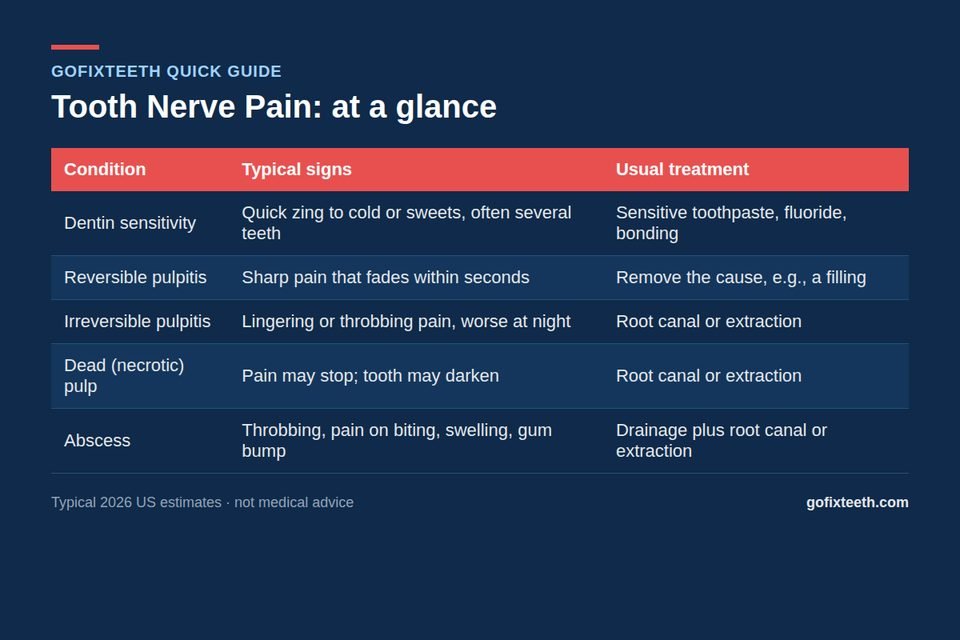
Dentists usually describe the state of the nerve in stages. This simplified overview shows how they often differ:
| Condition | Typical signs | Usual treatment |
|---|---|---|
| Dentin sensitivity | Quick zing to cold or sweets, often several teeth | Sensitive toothpaste, fluoride, bonding |
| Reversible pulpitis | Sharp pain that fades within seconds | Remove the cause, e.g., a filling |
| Irreversible pulpitis | Lingering or throbbing pain, worse at night | Root canal or extraction |
| Dead (necrotic) pulp | Pain may stop; tooth may darken | Root canal or extraction |
| Abscess | Throbbing, pain on biting, swelling, gum bump | Drainage plus root canal or extraction |
These categories overlap, and symptoms vary from person to person. A dentist uses your history, an exam, cold or electric tests and X-rays to tell them apart.
Reversible vs irreversible pulpitis
Reversible pulpitis
In reversible pulpitis, the nerve is irritated but still healthy enough to recover once the cause is removed. Common triggers are a cavity that has not yet reached the pulp, a recent filling, a worn or chipped area, or gum recession that exposes the root. The pain is usually sharp and brief: you sip something cold, feel a jolt, and it goes away within a few seconds after the cold is gone. The tooth usually does not hurt on its own.
Treatment focuses on the cause, such as filling a cavity, replacing a leaky filling or protecting exposed dentin. After that, the nerve often calms down over days to weeks.
Irreversible pulpitis
In irreversible pulpitis, the inflammation has gone too far for the pulp to heal. This often happens when deep decay reaches the nerve, after a crack, or after repeated dental work on the same tooth. Typical signs include pain to hot or cold that lingers for a while, throbbing pain that starts without a trigger, pain that wakes you at night, and pain that is hard to pinpoint or spreads to the ear, jaw or temple. Heat sometimes makes it worse while cold briefly helps.
Because the pulp cannot recover, the usual choices are a root canal to remove the nerve and save the tooth, or extraction. Cleveland Clinic explains that a root canal removes inflamed or infected pulp, then cleans, fills and seals the inside of the tooth.
When the pain suddenly stops
Some people notice that a severe toothache goes away on its own. That can mean the nerve has died rather than healed. A dead pulp can become infected and lead to an abscess, sometimes without much pain at first. Even if the pain is gone, have the tooth checked.
Common causes of tooth nerve pain
- Deep tooth decay. Cavities can work their way through enamel and dentin toward the pulp. MedlinePlus notes that untreated decay can lead to pain, infection and tooth loss.
- Cracked or broken teeth. Cracks can let bacteria and temperature changes reach the nerve. Pain when biting or releasing is a common clue.
- Large or repeated fillings and crowns. Each procedure stresses the pulp a little.
- Injury. A blow to the mouth can damage the nerve, sometimes with symptoms appearing weeks or months later.
- Grinding and clenching. Heavy forces can inflame the tissues around a tooth and make it sore.
- Gum disease and recession. Exposed roots are often sensitive, and advanced gum disease can affect the pulp.
Useful on Amazon for this job
As an Amazon Associate we earn from qualifying purchases. Always confirm fit for your exact vehicle or ask your dentist.
The Dental Recovery & Savings Bundle includes 4 ready-to-use scripts to lower your dental bill, so you know what to ask about root canal and crown pricing before you agree. You also get a printable day-by-day recovery calendar for after treatment. Instant PDF, $12, 30-day money-back promise.
Get the savings scripts →
Treatments for tooth nerve pain
At the dentist
- Fillings and desensitizing treatments for decay or exposed dentin when the nerve can recover.
- Pulp capping or partial pulp removal in some cases where the nerve is only slightly exposed or inflamed, more often in younger patients.
- Root canal treatment when the pulp is irreversibly inflamed or dead. The tooth is numbed, the pulp is removed, and the canals are cleaned and sealed. Many back teeth then need a crown. If you are nervous, see does a root canal hurt.
- Extraction when the tooth cannot be restored or a root canal is not the right choice for you. Our guide to root canal or pull the tooth compares both options.
Short-term relief until your visit
These steps may ease pain but do not fix an inflamed nerve:
- Use over-the-counter pain relievers exactly as the label directs, if they are safe for you. Ask a pharmacist if you take other medicines. Our guide to the best painkiller for tooth nerve pain covers common choices.
- Avoid very hot, very cold and sugary foods and drinks, and chew on the other side.
- Keep the area clean with gentle brushing and flossing to remove trapped food.
- Sleep with your head a little raised, which some people find reduces throbbing.
- Do not place aspirin or other pills directly on the gum, and be wary of products that claim to kill a tooth nerve at home. There is no safe, permanent home fix; see kill tooth pain nerve in 3 seconds permanently for why.
When tooth nerve pain is urgent
See a dentist promptly if…
- Hot or cold pain lingers after the trigger is gone
- The tooth throbs on its own or wakes you up at night
- Biting down hurts, or the tooth feels taller than the others
- Pain lasts more than a day or two, or keeps coming back
- A severe toothache suddenly stops, or the tooth looks darker
- You notice a pimple-like bump on the gum or a bad taste
Seek emergency care right away, or call 911, for facial or neck swelling that is spreading, fever with tooth pain, trouble opening your mouth, or trouble swallowing or breathing. Mayo Clinic notes that an untreated tooth abscess can spread to the jaw, neck and other areas, which can be serious.
Frequently asked questions
Can a tooth nerve heal on its own?
A mildly irritated nerve (reversible pulpitis) can often recover once the cause, like a cavity, is treated. An irreversibly inflamed or dead nerve does not heal and needs treatment.
How do I know if my tooth nerve is dying?
Lingering pain, throbbing, night pain or a tooth that darkens can be signs, but only a dentist can tell with tests and X-rays.
Why is tooth nerve pain worse at night?
Lying down can increase blood flow and pressure in the head, and there are fewer distractions. Night pain is a reason to see a dentist soon.
Can antibiotics fix tooth nerve pain?
Antibiotics do not treat an inflamed nerve. They may be used when there is a spreading infection, along with a root canal or extraction.
Does removing the nerve kill the tooth?
The tooth loses its feeling to hot and cold, but it can still function for many years, supported by the tissues around the root.
Sources
- Cleveland Clinic. Root Canal.
- Mayo Clinic. Tooth Abscess.
- Mayo Clinic. Cavities and Tooth Decay.
- MedlinePlus. Tooth Decay.
- MedlinePlus. Tooth Disorders.
This article is for general education and does not replace advice from your dentist, who can test the tooth and find the cause of your pain.