Zirconia Dental Implants vs Titanium: Cost, Pros & Cons
Zirconia (ceramic) teeth implants vs titanium in 2026: cost, molar implant tips, who they suit and what the evidence really shows so far.
✅ Quick answer
Zirconia dental implants are metal-free ceramic implants that can replace a missing tooth, and they typically cost about $3,500 to $7,000 per tooth (implant, abutment and crown) in the US in 2026, often somewhat more than titanium. They are a reasonable option for some people who want to avoid metal, but titanium still has far more long-term research behind it, especially for back teeth like molars, so most dentists treat titanium as the default and zirconia as a case-by-case choice. Typical 2026 US estimates; they vary by region and insurance.
If you have searched for “zirconia teeth implants,” you have probably seen them described as the natural, holistic or “next generation” choice. Some of that is fair. Zirconia is tooth-colored, does not corrode and is well tolerated by the gums. But the marketing often skips the part that matters most when you are spending thousands of dollars: how well these implants hold up over many years, and whether they are a good match for your specific tooth.
This guide compares zirconia and titanium implants side by side, explains what changes when the missing tooth is a molar, lays out typical costs and helps you figure out which questions to ask before you commit.
📩 Important: after you sign up, open the email from Go Fix Teeth and tap Confirm. Your PDF opens right away. Not there? Check Spam or Promotions.
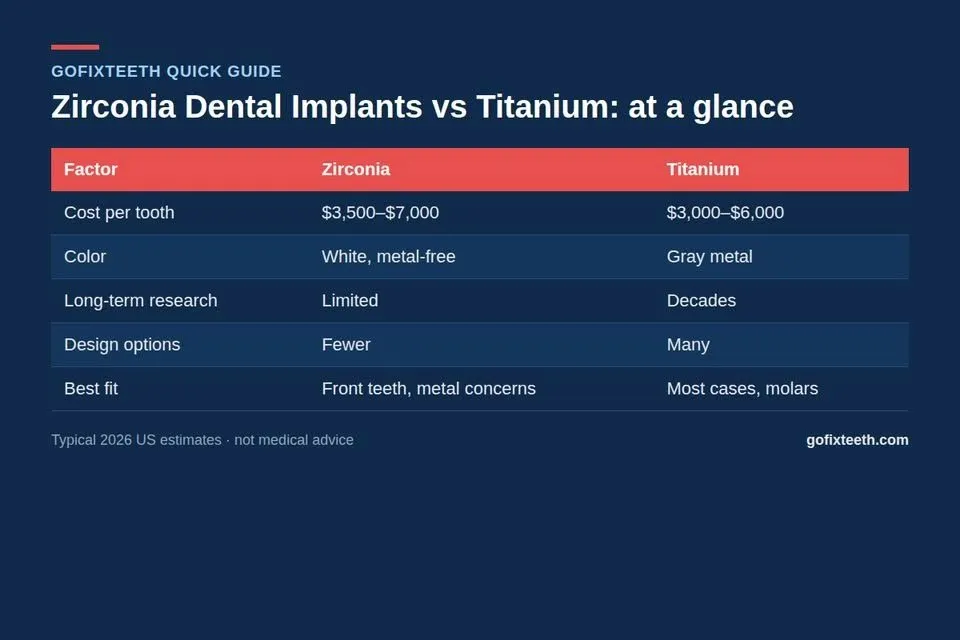
Zirconia vs titanium implants at a glance
| Factor | Zirconia | Titanium |
|---|---|---|
| Cost per tooth | $3,500–$7,000 | $3,000–$6,000 |
| Color | White, metal-free | Gray metal |
| Long-term research | Limited | Decades |
| Design options | Fewer | Many |
| Best fit | Front teeth, metal concerns | Most cases, molars |
Typical 2026 US estimates; they vary by region and insurance. Costs include the implant post, the abutment (connector) and the crown. They usually do not include extraction, bone grafting or a CT scan, which are covered below.
What zirconia implants are
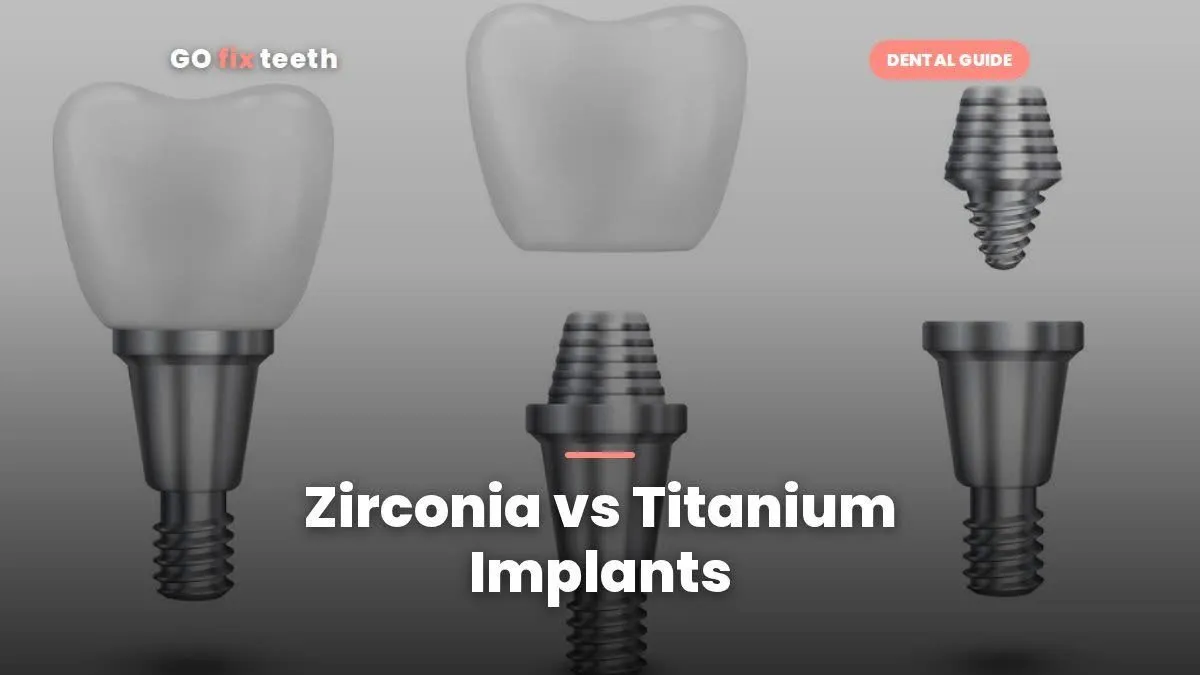
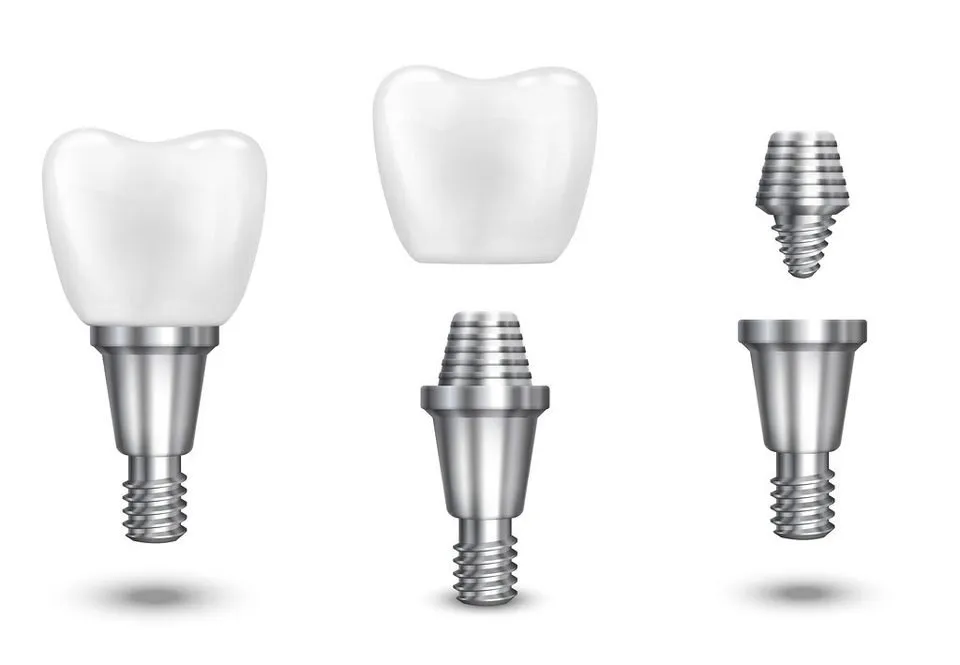
A dental implant is a small post placed in the jawbone to act as an artificial tooth root. Once the bone heals around it, a crown is attached on top. Most implants since the 1980s have been made of titanium or titanium alloys. Zirconia implants use zirconium dioxide, a very hard ceramic that is also used for crowns.
Zirconia implants come in two main designs:
- One-piece implants, where the post and the abutment are a single solid piece. These have been the most common zirconia design. The downside is less flexibility: the dentist cannot easily change the angle of the abutment, and the implant sticks out through the gum while it heals.
- Two-piece implants, where the abutment is attached separately, the way most titanium implants work. These give the dentist more options, but the connection between the parts has been a focus of engineering work, and there is less long-term data on these designs.
Possible benefits of zirconia
- No gray show-through. If you have thin gums, especially on an upper front tooth, a titanium implant can sometimes give the gum a faint gray tint. A white ceramic implant avoids that.
- Metal-free. Some patients simply prefer no metal in the body. True titanium allergy appears to be uncommon, but if you have a documented metal sensitivity, it is worth discussing with your dentist and doctor.
- Gum response. Zirconia tends to collect less plaque on its surface, and many dentists report healthy-looking gum tissue around it.
- No corrosion. Ceramic does not corrode, which some people find reassuring.
The honest drawbacks: what we don’t know yet
This is the part that matters most. Titanium implants have been studied for decades, in large numbers of patients, across many implant brands and situations. Zirconia implants have a much shorter and smaller research record. Studies so far have been encouraging in many cases, but there is simply less long-term evidence, particularly beyond the first several years and particularly for back teeth that take heavy chewing forces.
Other practical limits to know about:
- Brittleness. Ceramic is very hard but less forgiving than metal. A fractured implant is rare but harder to fix, and usually means removing the implant.
- Fewer restorative options. Titanium systems offer a huge range of sizes, angled abutments and parts. Zirconia systems have fewer choices, which can matter when bone or spacing is tricky.
- Fewer experienced providers. Many general dentists and oral surgeons place titanium implants routinely but place zirconia rarely or never. Experience with a specific system matters.
- Harder to use for full-arch work. Most All-on-4 style bridges and implant-supported dentures still rely on titanium.
If a provider tells you zirconia is proven to be better than titanium for everyone, treat that as a sales claim, not a fact.
Molar teeth implants: what’s different
“Molar teeth implant” is one of the most common searches about implants, and for good reason. Molars are the teeth most often lost to deep decay, failed root canals and cracks. Replacing one comes with a few special considerations:
- Heavy bite forces. Molars do most of your chewing. Implants there need to be strong, which is one reason many dentists prefer titanium or wider-diameter implants for molars. If you grind or clench, mention it; a night guard is often recommended afterward.
- Bone volume. After a molar is pulled, the bone can shrink. In the upper jaw, the sinus sits right above the molar roots, so a sinus lift may be needed to make room for the implant. In the lower jaw, the dentist must stay clear of the nerve that gives feeling to your lip and chin.
- Timing. Some molars can get an implant at the same visit as the extraction, but many need a few months of healing first. See our guide to same-day tooth extraction and implant for when that works.
- Crown material. Molar implant crowns are often solid zirconia or metal-ceramic, chosen for strength rather than looks.
A single molar implant with a titanium post typically lands in the same $3,000–$6,000 range as other teeth. A zirconia molar implant is possible, but ask the dentist how many they have placed in molar positions and what their own results have looked like.
Useful on Amazon for this job
As an Amazon Associate we earn from qualifying purchases. Always confirm fit for your exact vehicle or ask your dentist.
What to ask before choosing a ceramic implant
- One-piece or two-piece? Many zirconia implants are one piece, so the post sticks out through the gum during healing. That needs precise placement and careful protection while it heals.
- How does the crown attach? One-piece ceramic implants usually need a cemented crown. Ask how the dentist makes sure no extra cement is left under the gum, since leftover cement can cause bone loss.
- Insurance often pays the titanium rate, leaving the ceramic upcharge to you. Also check for missing tooth clauses and exclusions for bone grafts or custom abutments.
- Bite forces matter. Zirconia is strong but less forgiving of sideways grinding. If you clench or need a narrow implant, ask whether ceramic is a good fit for your bite.
- Protect it while it heals. Avoid chewing on that side and pressing the post with your tongue, since movement can stop the bone from fusing.
- Tell your hygienist it’s ceramic so they use gentle tools, and wear a night guard if you grind your teeth.
The Dental Recovery & Savings Bundle includes 4 ready-to-use scripts to lower your dental bill, so you know exactly what to ask about payment plans, cash discounts and itemized fees before you sign. You also get a printable day-by-day recovery calendar for the days after surgery. Instant PDF, $12, 30-day money-back promise.
Get the savings scripts →
Extra costs to plan for
The per-tooth price is only part of the total. Depending on your mouth, an implant plan may add:
- Consultation, exam and 3D (CBCT) scan: about $100–$600
- Tooth extraction: about $150–$650, more for a surgical extraction (see tooth extraction cost)
- Bone graft: about $300–$1,200 per site
- Sinus lift (upper molars): about $1,500–$3,500
- Sedation: about $200–$800 for IV sedation
Typical 2026 US estimates; they vary by region and insurance. Dental insurance often covers part of an implant crown or related procedures, but many plans have low annual maximums. Medicare Part A and B generally do not cover implants.
Who might choose zirconia, and who should probably skip it
Zirconia may make sense if:
- You are replacing a front tooth and have thin gum tissue where gray show-through is a real risk
- You have a documented metal sensitivity confirmed by a medical professional
- You have a strong personal preference for metal-free treatment and accept the trade-offs
- You have enough healthy bone and a provider with real experience in the system they use
Titanium is usually the safer pick if:
- The missing tooth is a molar and you clench or grind
- You need bone grafting, angled placement or other complex steps
- You want several implants to hold a bridge or denture
- You want the option with the longest track record
Some patients pick a middle path: a titanium implant with a tooth-colored zirconia abutment and crown, which reduces gray show-through while keeping the well-studied titanium root.
Questions to ask before you choose
- Which implant brand and design are you using, one-piece or two-piece?
- How many zirconia implants have you placed, and in which teeth?
- What happens, and what does it cost, if the implant fails or fractures?
- Do I need a bone graft or sinus lift, and is that in the quote?
- Would you recommend titanium for my tooth, and if so, why?
A good provider will answer these plainly and won’t push you toward one material without explaining why.
See a dentist promptly if…
- An implant feels loose or moves when you bite
- The gum around an implant is red, swollen, bleeding or draining
- You have pain that gets worse instead of better several days after surgery
- Your lip, chin or tongue stays numb after the anesthetic should have worn off
Seek emergency care right away, or call 911, for spreading facial swelling, fever with mouth pain, or trouble swallowing or breathing.
Frequently asked questions
Are zirconia implants better than titanium?
Not overall. Zirconia has real advantages for looks and for people avoiding metal, but titanium has much more long-term research and more design options. Neither is best for everyone.
How long do zirconia implants last?
Many appear to do well in the years studied so far, but there is less long-term data than for titanium, so no one can promise a lifespan with the same confidence.
Can you get a zirconia implant for a molar?
Yes, but molars take heavy forces, and many dentists prefer titanium there. Ask about the provider’s own experience with zirconia molars.
Does insurance cover zirconia implants?
Coverage is often the same as for any implant, if the plan covers implants at all. You may pay the difference if zirconia costs more.
Are zirconia implants “holistic” or safer?
They are metal-free, which some people prefer. That does not by itself make them safer or healthier for most patients.
Sources
- Cleveland Clinic. Dental Implants.
- American Dental Association, MouthHealthy. Implants.
- MedlinePlus. Dental Health.
- National Institute of Dental and Craniofacial Research. Finding Low-Cost Dental Care.
This article is for general education and does not replace advice from your dentist, who can examine your mouth and recommend the right implant for you.