Full Mouth Dental Implants Cost in 2026: Real US Prices
Dental implant cost for the whole mouth in 2026: All-on-4, All-on-6, snap-in dentures and single implants, per arch vs full mouth, and how to pay.
✅ Quick answer
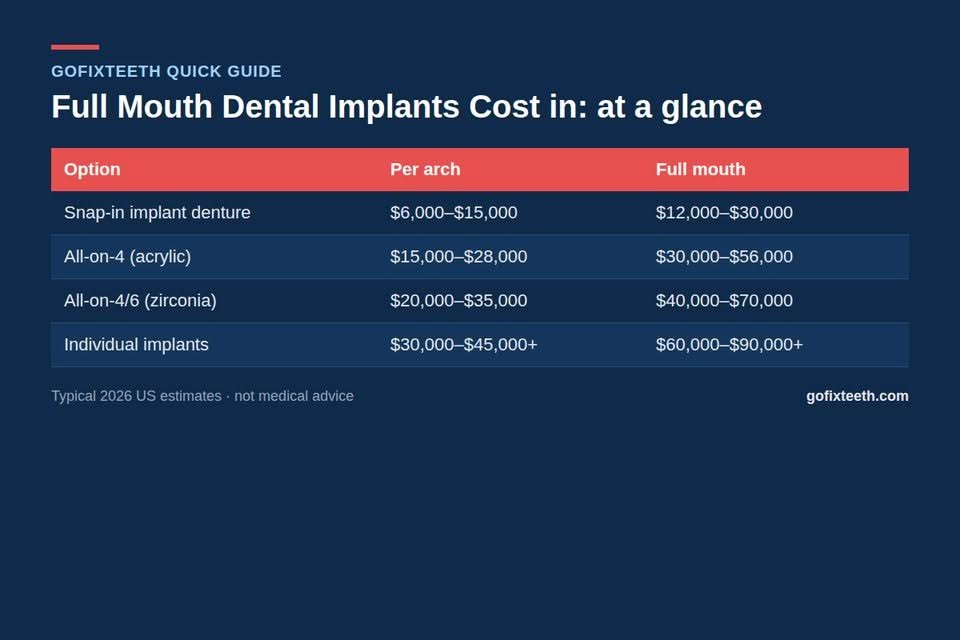
Full mouth dental implants typically cost about $30,000 to $70,000 for both arches with a fixed All-on-4 or All-on-6 style bridge, or roughly $15,000 to $35,000 per arch, in the US in 2026. Implant-supported snap-in dentures cost less, about $12,000–$30,000 for both arches, while replacing every tooth with its own implant can pass $60,000–$90,000. Typical 2026 US estimates; they vary by region and insurance.
If you’re facing the loss of most or all of your teeth, or you’re tired of a loose denture, a full mouth of implants can feel life-changing. It also comes with one of the biggest price tags in dentistry. Quotes vary widely between offices, and the advertised “starting at” price is rarely what people end up paying.
This guide breaks down the main full-mouth options, what’s usually included in a quote, the extras that change the total, how people pay for it, and the red flags that come with offers that seem too cheap.
📩 Important: after you sign up, open the email from Go Fix Teeth and tap Confirm. Your PDF opens right away. Not there? Check Spam or Promotions.
Full mouth dental implant cost by option
| Option | Per arch | Full mouth |
|---|---|---|
| Snap-in implant denture | $6,000–$15,000 | $12,000–$30,000 |
| All-on-4 (acrylic) | $15,000–$28,000 | $30,000–$56,000 |
| All-on-4/6 (zirconia) | $20,000–$35,000 | $40,000–$70,000 |
| Individual implants | $30,000–$45,000+ | $60,000–$90,000+ |
Typical 2026 US estimates; they vary by region and insurance. Big-city prices tend to sit at the top of these ranges. The final cost depends on how many teeth need to come out, how much bone you have, the bridge material and whether sedation is included.
The main full-mouth options explained
All-on-4
Four implants are placed in each jaw, with the back two often angled to make the most of available bone. A full arch of teeth is screwed onto them, so it doesn’t come out at home. In many cases, a temporary fixed bridge goes in on the day of surgery, and the final bridge is made a few months later once the implants have healed.
All-on-6
The same idea with five or six implants per arch. More implants spread the chewing load and give a backup if one implant fails. It usually costs more and needs enough bone for the extra posts. Your surgeon will recommend a number based on your bone and bite.
Implant-supported (snap-in) dentures
Two to four implants hold a denture that snaps into place with attachments. You remove it at night to clean it. It’s much more stable than a regular denture and usually far less expensive than a fixed bridge. It’s a common middle ground, especially for the lower jaw, where regular dentures tend to move. Compare it in dentures vs implants and permanent dentures.
Individual implants for every tooth
Replacing each tooth with its own implant and crown is rarely needed. It’s the most expensive route and needs a lot of bone and treatment time. Most people with no teeth do well with a full-arch bridge on fewer implants.
What a full-arch quote usually includes, and what it doesn’t
Before comparing prices, make sure you’re comparing the same thing. Ask each office to list:
- Consultation, 3D (CBCT) scan and records
- Extractions of remaining teeth (see tooth extraction cost)
- Bone smoothing or bone grafting
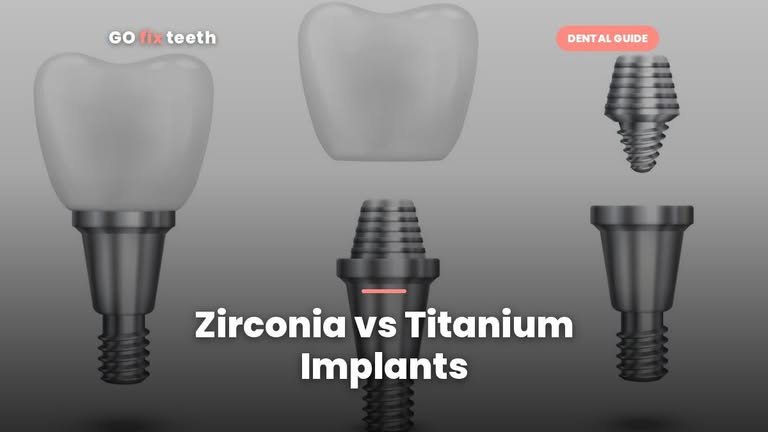
- The implants and their abutments (connectors)
- Sedation or general anesthesia
- The temporary (same-day) bridge
- The final bridge and its material: acrylic, acrylic with a metal bar, or zirconia
- Follow-up visits, adjustments and the night guard
- What happens if an implant fails during healing
A low quote that only covers the temporary teeth or one arch can look like a bargain until the final bridge is added. Also ask about long-term upkeep: acrylic teeth can wear or chip and may need replacing years later, and all full-arch bridges need professional cleanings with the bridge removed now and then.
Useful on Amazon for this job
As an Amazon Associate we earn from qualifying purchases. Always confirm fit for your exact vehicle or ask your dentist.
What full-mouth implant ads often leave out
- Four implants isn’t right for everyone. People who clench or have softer upper bone may need more. Ask whether a segmented design (two or three bridges per arch) suits you, since it can be easier to repair.
- Get the final teeth in writing. Low quotes may include only surgery and the temporary teeth. Make sure extractions, bone leveling, temporary repairs and the final arches are in one written fee.
- Medical insurance rarely helps. It usually covers implants only in special cases such as major facial injury or cancer surgery, so don’t rely on a promise that it will.
- Ask about the opposing arch material. Two hard zirconia arches biting on each other can click and transmit strong forces. Your prosthodontist may suggest a different material for one arch.
- Soft food during healing is a must, because the temporary bridge can break and the implants haven’t fused yet. Use a water flosser on a low setting early on.
- Plan for maintenance: regular visits, X-rays, cleaning under the bridge daily and often a night guard.
The Dental Recovery & Savings Bundle includes 4 ready-to-use scripts to lower your dental bill, so you know how to ask for an itemized quote, a cash discount and a payment plan before you sign. You also get a printable day-by-day recovery calendar for the weeks after surgery. Instant PDF, $12, 30-day money-back promise.
Get the savings scripts →
Extra costs that can raise the total
- Bone grafting: about $300–$1,200 per site, more for larger grafts
- Sinus lift (upper jaw): about $1,500–$3,500 per side
- IV sedation or general anesthesia: about $500–$2,000 or more for a long surgery
- Zirconia upgrade on the final bridge: often several thousand dollars per arch
- Treatment of gum disease before surgery
Typical 2026 US estimates; they vary by region and insurance.
Does insurance cover full mouth implants?
Dental insurance usually helps only a little. Many plans have annual maximums of about $1,000 to $2,000, and some exclude implants entirely. Some will pay toward extractions, a denture-level amount or part of the bridge. Medical insurance occasionally covers parts of the surgery after trauma, cancer treatment or certain medical conditions, so ask the office to check both.
If your plan pays anything, ask the office to send a pre-treatment estimate before surgery so you know exactly which parts are covered and how much of your annual maximum will be used. Splitting treatment across two benefit years can sometimes let you use two annual maximums, if your surgeon says the timing is safe.
Original Medicare (Parts A and B) generally doesn’t cover dental implants. Some Medicare Advantage plans include dental benefits, but these often have low yearly limits. Medicaid adult dental coverage varies a lot by state and rarely covers full-arch implants.
How people pay for full mouth implants
- Treat one arch at a time. Many people start with the arch that bothers them most and use a denture on the other.
- Consider a snap-in denture first. Some systems can later be upgraded or converted, though not always; ask.
- In-office payment plans or healthcare financing. Read the terms closely: some promotional plans add all the deferred interest if you don’t pay off the balance in time.
- Dental schools and residency programs sometimes offer implant treatment at lower fees, with longer timelines.
- HSA or FSA funds can generally be used for implant treatment.
- Get two or three itemized quotes from experienced surgeons or prosthodontists.
Warning signs of a too-cheap offer
Bargain full-mouth offers are common online, both in the US and abroad. Be cautious if:
- The price is quoted without a 3D scan or an in-person exam
- The ad price covers only one arch, only the temporary teeth or only “starting at” cases
- You’re pressured to sign or pay a large deposit the same day
- No one can tell you which implant brand is used (replacement parts can be hard to find for obscure systems)
- Healthy teeth are scheduled for removal without a clear explanation
- Follow-up care, adjustments and failed-implant policies aren’t in writing
Also ask who will handle your care if the clinic is far away, since a full-arch bridge needs regular checkups and occasional adjustments for as long as you have it. A full-arch case is a big surgery followed by years of maintenance. Choosing an experienced team with clear follow-up is usually worth more than saving a few thousand dollars up front.
See a dentist promptly if…
- An implant or bridge feels loose, cracks or clicks when you bite
- Your gums around implants are red, swollen, bleeding or draining
- Pain or swelling gets worse after the first few days of healing
- Numbness in your lip or chin doesn’t go away after surgery
Seek emergency care right away, or call 911, for spreading facial swelling, high fever, heavy bleeding that won’t stop with pressure, or trouble swallowing or breathing.
Frequently asked questions
How much does All-on-4 cost per arch?
Typically about $15,000 to $28,000 per arch with an acrylic bridge, and more with zirconia, in the US in 2026.
Is All-on-6 better than All-on-4?
Not automatically. More implants spread the load, but the right number depends on your bone, bite and the surgeon’s plan.
Can I get full mouth implants in one day?
Many people get temporary fixed teeth on surgery day, but the final bridge is usually made a few months later after healing.
How long do full mouth implants last?
With good care and regular checkups, implants can last many years. The teeth on the bridge, especially acrylic, may need repair or replacement over time.
What is the cheapest way to get implants for the whole mouth?
Implant-supported snap-in dentures usually cost the least. Treating one arch at a time can also spread out the expense.
Sources
- Cleveland Clinic. Dental Implants.
- American Dental Association, MouthHealthy. Implants.
- National Institute of Dental and Craniofacial Research. Finding Low-Cost Dental Care.
- MedlinePlus. Dental Health.
This article is for general education and does not replace advice from your dentist or oral surgeon, who can examine you and give you an exact quote.