Dental Veneers for Missing Teeth: What Works Instead
Can dental veneers replace missing teeth? The honest answer, plus bridges, implants, flippers and partials compared by cost, comfort and lifespan.
✅ Quick answer
No, dental veneers can’t replace a missing tooth, because a veneer is a thin shell that has to be bonded to the front of an existing tooth. To fill a gap, the real options are a dental implant (about $3,000–$6,000), a bridge (about $2,000–$5,000), a partial denture (about $900–$3,000) or a temporary flipper (about $300–$1,000), and veneers can sometimes be added on nearby teeth so everything matches. Typical 2026 US estimates; they vary by region and insurance.
It’s a very common question, especially from people who want a whole new smile and also have a gap or two. Veneers get a lot of attention online, so it’s natural to wonder whether they can cover a missing tooth at the same time. The short answer is that veneers improve the look of teeth you already have. They don’t create a new tooth where there isn’t one.
The good news is that there are several solid ways to replace a missing tooth, and they can be combined with veneers when the goal is a matching, natural-looking smile. Here’s how each option works, what it costs and who it suits.
📩 Important: after you sign up, open the email from Go Fix Teeth and tap Confirm. Your PDF opens right away. Not there? Check Spam or Promotions.
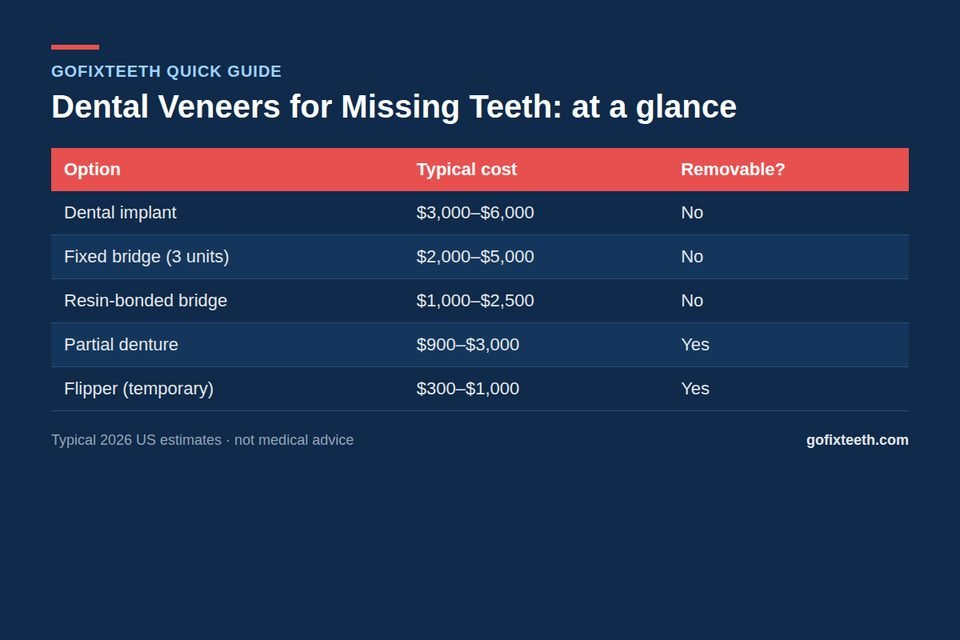
Options for missing teeth compared
| Option | Typical cost | Removable? |
|---|---|---|
| Dental implant | $3,000–$6,000 | No |
| Fixed bridge (3 units) | $2,000–$5,000 | No |
| Resin-bonded bridge | $1,000–$2,500 | No |
| Partial denture | $900–$3,000 | Yes |
| Flipper (temporary) | $300–$1,000 | Yes |
Typical 2026 US estimates; they vary by region and insurance. Implant prices include the post, abutment and crown. Extractions, bone grafts and scans are extra. Porcelain veneers, if you add them on neighboring teeth, typically run about $1,000–$2,500 per tooth.
Why veneers can’t fill a gap
A porcelain or composite veneer is a thin layer, about as thick as a fingernail, that is bonded to the front surface of a natural tooth. It changes color, shape or small spacing issues. It depends completely on the tooth behind it for support and for chewing strength.
Where a tooth is missing, there’s nothing to bond to. A veneer can’t hang in the air or span a space. Some clinics can widen the veneers on the teeth next to a small gap to close extra space, but that only works for minor spacing, not for a full missing tooth. For the differences between covering a tooth and capping it, see tooth crown vs veneer.
What about snap-on or clip-on veneers? These are removable cosmetic shells that fit over your existing teeth, and some versions include a fake tooth in a gap. They can change how your smile looks in photos, but they aren’t designed for eating, can trap food against your teeth and don’t prevent the problems that come with a missing tooth. They aren’t a long-term replacement.
Real ways to replace a missing tooth
Dental implant
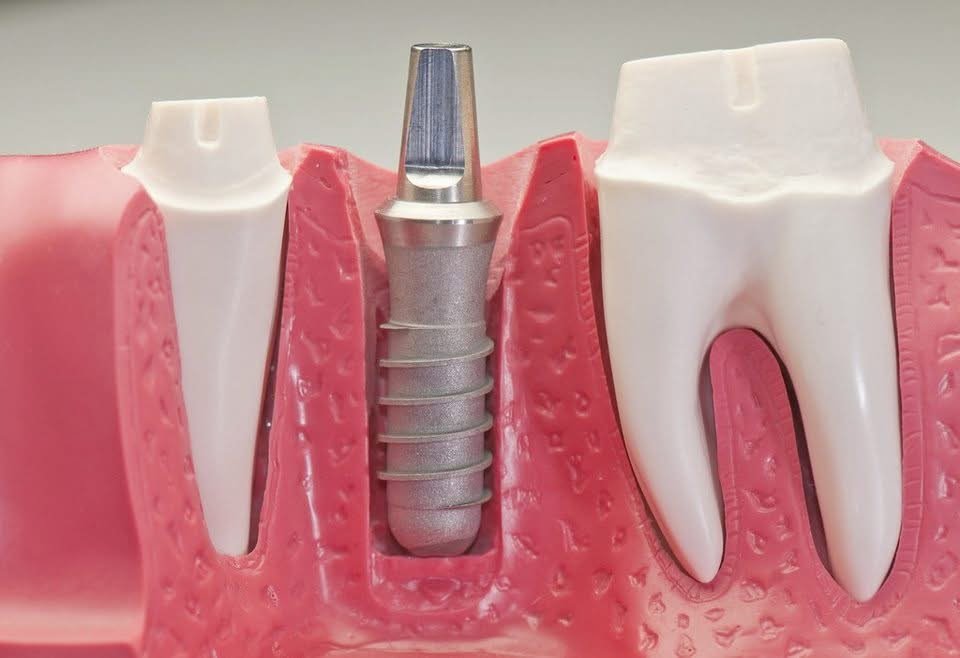
An implant is a post placed in the jawbone that acts like a tooth root, topped with a crown. It doesn’t rely on neighboring teeth, and it helps keep the bone in that spot from shrinking. It’s often considered the closest thing to a natural tooth, but it costs the most up front and takes several months from start to finish. You need enough healthy bone, or a graft. Titanium is the standard; our guide to zirconia dental implants covers the metal-free option.
Fixed bridge
A traditional bridge uses crowns on the teeth on each side of the gap to hold a false tooth in the middle. It’s fixed in place and usually done in two or three visits. The trade-off is that the supporting teeth have to be shaped for crowns. If those teeth already have big fillings, that can be an advantage; if they’re healthy, it’s a real cost to consider.
Resin-bonded (Maryland) bridge
This type uses small metal or ceramic wings bonded to the back of the neighboring teeth. It removes little or no tooth structure, which makes it popular for front teeth. It can come loose and need re-bonding, and it’s not usually a good fit for back teeth with heavy chewing forces.
Partial denture
A removable partial denture replaces one or more teeth with false teeth on a base that clips onto your natural teeth. Cast-metal frames are sturdy; flexible nylon versions are lighter and have no metal clasps. They’re less expensive than implants or bridges, but you take them out to clean them and at night. See our guides to flexible dentures and partial dentures before and after.
Flipper
A dental flipper is a lightweight acrylic partial that holds one or two false teeth. It’s mainly used as a temporary tooth while you heal from an extraction or wait for an implant, though some people wear one longer for budget reasons.
Useful on Amazon for this job
As an Amazon Associate we earn from qualifying purchases. Always confirm fit for your exact vehicle or ask your dentist.
The Dental Recovery & Savings Bundle includes 4 ready-to-use scripts to lower your dental bill, so you can ask about phased treatment, cash discounts and payment plans when you get your implant, bridge or veneer quote. You also get a printable day-by-day recovery calendar for after the procedure. Instant PDF, $12, 30-day money-back promise.
Get the savings scripts →
Combining veneers with a tooth replacement
Many smile makeovers mix treatments. A common plan looks like this:
- Replace the missing tooth with an implant or bridge
- Place veneers on visible neighboring teeth so color and shape match
- Whiten any remaining natural teeth first, since veneers and crowns don’t whiten later
The order matters. Your dentist will usually settle the shade before making the final crowns and veneers so everything matches. If you’re getting a bridge, the crowns on the supporting teeth already cover those teeth fully, so they won’t also need veneers.
Why replacing a missing tooth matters
It isn’t only about appearance. When a tooth is lost, the teeth next to it can slowly tip into the space, the opposing tooth can drift up or down, and the bone in that area can shrink over time. That can change your bite, make cleaning harder and limit your options later. You don’t have to replace every missing tooth right away, especially at the very back of the mouth, but it’s worth discussing with your dentist. Our guide on how to replace a missing tooth walks through the decision.
How to choose and save
- Think long term. A flipper is cheap now but may need replacing; an implant costs more now but doesn’t involve neighboring teeth.
- Ask about insurance. Many plans cover part of bridges and partial dentures as major services, often around 50% up to the annual maximum. Implant coverage varies widely, and cosmetic veneers usually aren’t covered.
- Stage the work. Replace the tooth first, then add veneers later if you still want them.
- Consider dental schools and community health centers for lower fees.
- Use an FSA or HSA for medically needed treatment.
See a dentist promptly if…
- A tooth was knocked out (a dentist may be able to put it back if you are seen very quickly)
- A tooth next to a gap feels loose or painful
- Your gum is swollen or there’s pain where a tooth used to be
- A bridge or partial denture is loose, broken or rubbing your gums
Seek emergency care right away, or call 911, for facial swelling that is spreading, fever with mouth pain, or trouble swallowing or breathing.
Frequently asked questions
Can you get veneers if you have a missing tooth?
Yes, on your remaining teeth, but the missing tooth itself needs an implant, bridge or partial denture. They’re often planned together.
Can veneers close a gap between teeth?
Small gaps, yes, by making the veneers slightly wider. A space where a whole tooth is missing can’t be closed with veneers alone.
What is the cheapest way to replace a missing front tooth?
A flipper is usually the least expensive, followed by a partial denture. They’re removable and often less comfortable than fixed options.
Are snap-on veneers good for missing teeth?
They can hide a gap cosmetically, but they’re not made for chewing and aren’t a long-term tooth replacement.
Is a bridge or an implant better?
It depends on your bone, the neighboring teeth, your budget and your health. An implant spares the nearby teeth; a bridge is faster and avoids surgery.
Sources
- American Dental Association, MouthHealthy. Veneers.
- American Dental Association, MouthHealthy. Implants.
- Cleveland Clinic. Dental Implants.
- MedlinePlus. Dental Health.
This article is for general education and does not replace advice from your dentist, who can examine your mouth and recommend the right way to replace a missing tooth.