Gum Graft Cost in 2026: Prices Per Tooth, Insurance and Recovery
How much does a gum graft cost in 2026? Per-tooth prices for connective tissue, free gingival, donor tissue and pinhole grafts, plus insurance and recovery.
✅ Quick answer
A gum graft typically costs about $700 to $1,600 per tooth or site without insurance in the US in 2026, depending on the type of graft and who does it. Donor tissue (allograft) can add $200 to $500 per site for the material, and grafting several neighboring teeth in one visit often lowers the price per tooth. With insurance that covers it as medically necessary, many patients pay roughly $300 to $900 per site. Typical 2026 US estimates; they vary by region and insurance.
If your dentist has told you your gums are pulling back from your teeth, you may have heard the words “gum graft” for the first time. Gum recession can expose the root of a tooth, which can make the tooth sensitive, more likely to get root cavities and, over time, less stable. A gum graft adds tissue back to the area to cover or protect the root.
The price can be a shock, partly because grafts are usually quoted per tooth or per area, and many people need more than one. This guide explains the main types of gum grafts, typical gum graft costs, what insurance usually does and doesn’t pay, and what recovery is really like.
📩 Important: after you sign up, open the email from Go Fix Teeth and tap Confirm. Your PDF opens right away. Not there? Check Spam or Promotions.
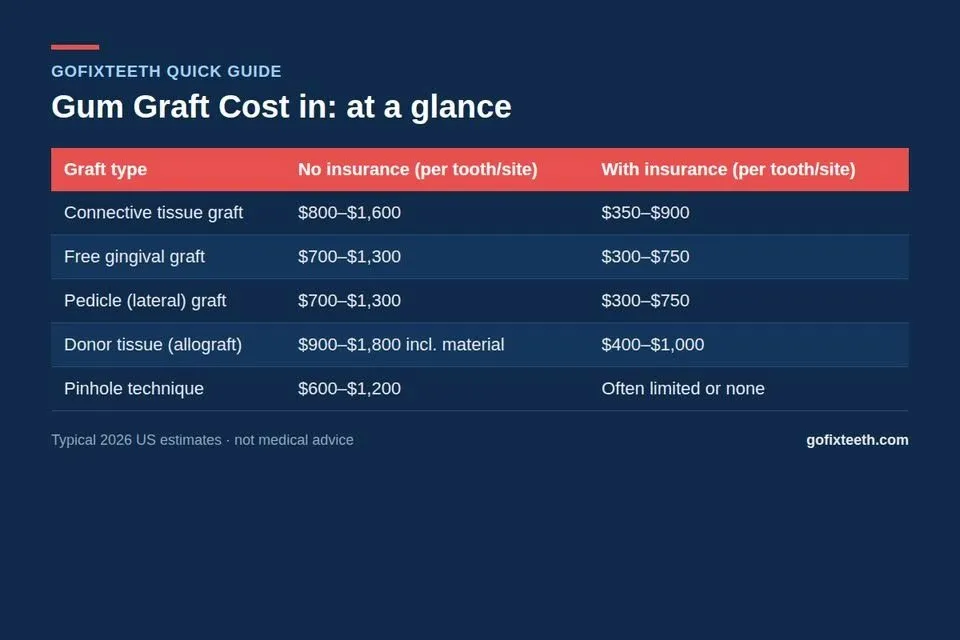
How much does a gum graft cost? (2026 prices)
| Graft type | No insurance (per tooth/site) | With insurance (per tooth/site) |
|---|---|---|
| Connective tissue graft | $800–$1,600 | $350–$900 |
| Free gingival graft | $700–$1,300 | $300–$750 |
| Pedicle (lateral) graft | $700–$1,300 | $300–$750 |
| Donor tissue (allograft) | $900–$1,800 incl. material | $400–$1,000 |
| Pinhole technique | $600–$1,200 | Often limited or none |
Typical 2026 US estimates; they vary by region and insurance. “With insurance” assumes a plan that treats gum grafting as periodontal surgery, often paid at around 50% after the deductible, and that the graft is considered medically necessary. Your annual maximum can run out quickly with grafting, so the real out-of-pocket cost for several teeth may be higher than the per-site numbers suggest.
Many offices discount each additional tooth in the same area, because the work is done through one opening and with one donor site. Pinhole treatment is often quoted for a group of teeth or a whole arch rather than one tooth, so ask how the price is built.
The main types of gum grafts
Connective tissue graft
This is the most common graft for covering exposed roots. The periodontist opens a small flap on the roof of your mouth, takes a thin piece of tissue from underneath, and stitches it over the exposed root. The palate is closed with stitches. It generally gives good root coverage and natural-looking results, but you have two healing areas instead of one.
Free gingival graft
Here, the tissue is taken directly from the surface of the palate. It’s often used to thicken thin gums and add firm tissue around a tooth, rather than mainly to cover a root. The palate site heals on its own and can be more tender for the first week or two.
Pedicle graft
In a pedicle (or lateral) graft, gum tissue next to the problem tooth is partly cut and rotated over the exposed root while staying attached at one edge. It only works when there is enough healthy gum nearby, but it avoids a palate wound.
Donor tissue (allograft) and other materials
Instead of using your own palate, the periodontist can use processed donor tissue from a tissue bank, or in some cases an animal-derived or collagen material. This means no palate wound, which many patients like, and it can make grafting several teeth easier. The material adds cost, and your periodontist can explain whether results for your situation are similar to using your own tissue.
Pinhole technique
The pinhole approach uses a small entry hole in the gum to loosen tissue and slide it down over the roots, usually with collagen strips to help hold it in place. There’s no palate wound and often fewer stitches. It’s not right for every case, fewer dentists offer it, and insurance may treat it differently from a traditional graft, so confirm coverage in writing first.
Periodontist vs general dentist
Most gum grafts in the US are done by periodontists, the specialists who treat gums and the bone around teeth. Some general dentists with extra training also do grafts. A periodontist usually charges more per visit, but they do these procedures often and can handle more complex recession.
Either way, ask how many grafts of this type they do, what results you can reasonably expect for your teeth, and whether they can show you before-and-after photos of similar cases. A good provider will also tell you honestly if a graft isn’t needed yet.
When is a gum graft needed?
Not every bit of gum recession needs surgery. A dentist may suggest a graft when:
- A root is exposed and very sensitive, or keeps getting root cavities
- Recession is getting worse between checkups
- The gum around a tooth is very thin, with little firm tissue left
- Recession is affecting the look of your smile, especially on front teeth
- Orthodontic treatment or a planned crown could make thin gums recede further
Mild, stable recession is often just watched. Your dentist may suggest a softer toothbrush, gentler brushing, a desensitizing toothpaste and treating any gum disease first. If grinding, an aggressive brushing habit or a lip or tongue tie is part of the cause, addressing that helps the graft last.
Useful on Amazon for this job
As an Amazon Associate we earn from qualifying purchases. Always confirm fit for your exact vehicle or ask your dentist.
Gum graft tips from a periodontist’s point of view
- Neighboring teeth cost less. The first tooth in an area is billed at the full fee and nearby teeth often at a lower fee, so treating them together can save money.
- How it’s documented matters for insurance. Plans usually pay when recession is progressing or there’s little firm gum left, not for looks or sensitivity alone.
- Your own tissue vs donor tissue. Tissue from the roof of your mouth is a gold standard; donor tissue avoids a second wound but may carry a separate material fee.
- Ask about the bone between the teeth. Full root coverage is more predictable when that bone is intact. A tight lip or cheek muscle (frenum) may also need to be released.
- Don’t pull your lip to look at it for the first two weeks, and don’t brush or floss the area until your periodontist says so.
- A whitish layer in week one is normal. Call if the graft moves, the palate bleeds heavily, or swelling and pus appear after day three.
The Dental Recovery & Savings Bundle includes 4 ready-to-use scripts to lower your dental bill, so you know exactly what to ask about cash prices, multi-tooth discounts and payment plans before you book. You also get a printable day-by-day recovery calendar to track the first weeks after surgery, when soft foods and gentle care matter most. Instant PDF, $12, 30-day money-back promise.
Get the savings scripts →
Does insurance cover a gum graft?
Many dental plans pay part of a gum graft when it’s done to treat recession, root exposure or gum disease, rather than purely for looks. It’s commonly listed as a major service, often covered at about 50% after the deductible. Some plans have waiting periods of 6 to 12 months for major work.
Things that commonly affect coverage:
- Documentation. Insurers often want measurements of the recession, X-rays and sometimes photos. Ask the office to send a pre-treatment estimate.
- Annual maximum. Many plans cap benefits at around $1,000 to $2,000 per year. Spreading grafts over two plan years can help.
- Donor material. Some plans pay for the surgery but not the allograft material.
- Newer techniques. Pinhole treatment may be paid at a lower rate or not at all.
- Network. Check whether the periodontist is in your plan’s network; out-of-network fees can be much higher.
Ways to lower the cost
- Ask about multi-tooth pricing if several neighboring teeth need treatment.
- Get a second opinion. Another periodontist may suggest a different graft type or fewer sites.
- Dental schools with periodontics programs often charge lower fees for supervised care.
- Ask for the cash price or an in-office payment plan.
- Use an FSA or HSA to pay with pre-tax money.
- Time it with your benefits. Splitting treatment across plan years can let insurance pay more in total.
Gum graft recovery: what to expect
Most people go home the same day with local numbing, and some choose light sedation. The first few days are usually the most uncomfortable, especially if tissue was taken from the palate. Many people describe the palate as feeling like a bad pizza burn.
- First 1 to 2 weeks: soft, cool foods such as yogurt, eggs, pasta and smoothies (no straws if your periodontist advises against them). Avoid crunchy, spicy and very hot foods.
- Don’t brush or floss the graft until you’re told to. You’ll likely use a prescribed rinse instead.
- Don’t pull your lip to look at the area, since that can move the graft.
- Pain is usually managed with over-the-counter pain relievers as your provider directs.
- Stitches are often removed or checked at about 1 to 2 weeks.
Gums usually look healed in a few weeks, while full maturing of the tissue takes a few months. Results depend on your gums, the graft type and how well the cause of the recession is controlled.
See a dentist promptly if…
- Your gums are bleeding, swollen or pulling back quickly
- A tooth feels loose or your bite has changed
- After a graft, bleeding doesn’t slow with gentle pressure from gauze or a damp tea bag for 30 minutes
- Pain gets worse after the first few days, or the graft looks like it moved or came loose
Seek emergency care right away, or call 911, for facial swelling that is spreading, fever with mouth pain, heavy bleeding that won’t stop, or trouble swallowing or breathing.
Frequently asked questions
How much is a gum graft per tooth?
Typically about $700 to $1,600 per tooth or site without insurance in the US in 2026, depending on the graft type and the provider.
Is a gum graft worth it?
When a root is exposed, sensitive or recession is getting worse, a graft can protect the tooth and help keep it long term. Mild, stable recession may only need monitoring.
Does a gum graft hurt?
The procedure is done with numbing. Soreness for several days afterward is common, especially at the palate, and is usually managed with over-the-counter pain relievers.
How long does a gum graft last?
Many grafts last for years. Gentle brushing, treating gum disease and managing grinding help protect the result.
Will gums grow back without a graft?
No. Lost gum tissue doesn’t grow back on its own, though treatment can stop recession from getting worse.
Is the pinhole technique cheaper?
Not always. It can cost about the same per tooth, and insurance may pay less for it, so compare written quotes.
Sources
- National Institute of Dental and Craniofacial Research. Gum Disease.
- American Dental Association, MouthHealthy. Gum Disease.
- Mayo Clinic. Periodontitis: Symptoms and Causes.
- MedlinePlus. Gum Disease.
- National Institute of Dental and Craniofacial Research. Finding Low-Cost Dental Care.
This article is for general education and does not replace advice from your dentist or periodontist, who can examine your gums and give you an exact quote.