Tooth Abscess Stages: What Each One Looks and Feels Like
The stages of a tooth abscess, from decay to pulpitis to a spreading infection: what you see and feel at each, treatment and cost, and when to go to the ER.
✅ Quick answer
A tooth abscess usually develops in stages: tooth decay breaks through the enamel, reaches the nerve and causes pulpitis (inflamed pulp), the nerve dies, and infection forms a pocket of pus at the root tip (periapical abscess). Untreated, it can spread into the jaw, face or neck. A dentist treats it by draining the infection and either doing a root canal or pulling the tooth. Antibiotics alone don’t cure it. Facial swelling, fever, or trouble swallowing or breathing needs the ER right away.
Many people search for pictures of tooth abscess stages because they’re trying to figure out how serious their own tooth is. Photos can be misleading, though, since the same stage can look very different from one mouth to another, and the most important parts of an abscess are often hidden under the gum or inside the bone.
Instead, this guide describes in plain words what you’d typically see and feel at each stage, how the different types of abscess differ, what treatment and cost to expect, and the warning signs that mean you need emergency care, not just a dentist appointment.
📩 Important: after you sign up, open the email from Go Fix Teeth and tap Confirm. Your PDF opens right away. Not there? Check Spam or Promotions.
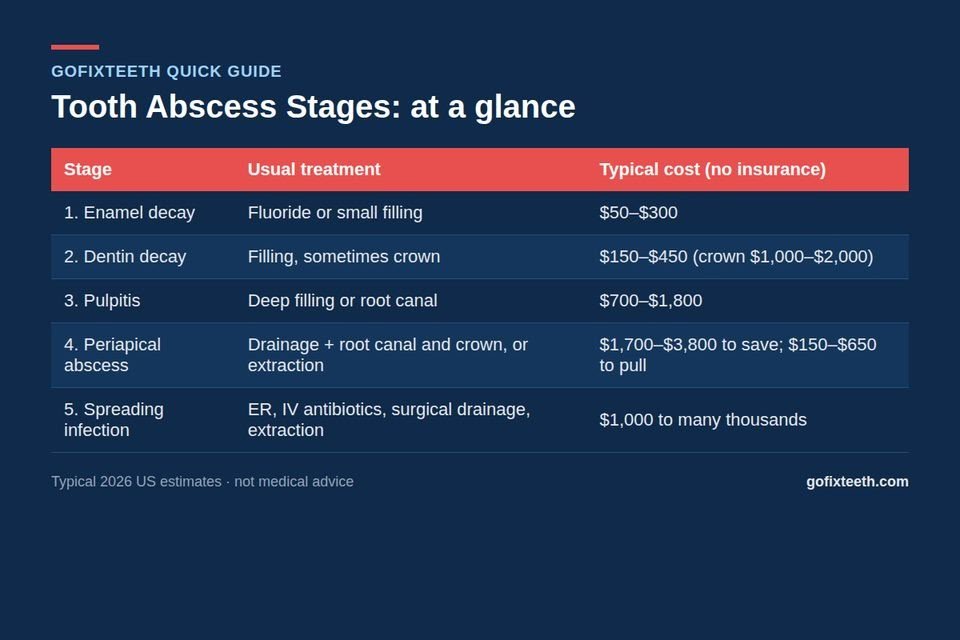
Tooth abscess stages at a glance

| Stage | Usual treatment | Typical cost (no insurance) |
|---|---|---|
| 1. Enamel decay | Fluoride or small filling | $50–$300 |
| 2. Dentin decay | Filling, sometimes crown | $150–$450 (crown $1,000–$2,000) |
| 3. Pulpitis | Deep filling or root canal | $700–$1,800 |
| 4. Periapical abscess | Drainage + root canal and crown, or extraction | $1,700–$3,800 to save; $150–$650 to pull |
| 5. Spreading infection | ER, IV antibiotics, surgical drainage, extraction | $1,000 to many thousands |
Typical 2026 US estimates; they vary by region and insurance. The cost to save a tooth includes the root canal (higher for molars) and a crown, which back teeth usually need afterward. The earlier the stage, the cheaper and simpler the fix, which is the strongest reason not to wait.
Stage 1: Enamel decay
What you might see: a chalky white spot, or a light brown or dark area on the tooth, often near the gum line or in the grooves of back teeth.
What you might feel: usually nothing. Enamel has no nerves.
At this point there’s no abscess. Fluoride treatments and better brushing can sometimes stop or even reverse very early spots. Once a true hole forms, a small filling is needed.
Stage 2: Decay reaches the dentin
What you might see: a visible hole or darker cavity, or a spot where food gets stuck.
What you might feel: sensitivity to sweets, cold or hot that goes away quickly once the trigger is gone.
Dentin is softer than enamel and has tiny channels that lead toward the nerve, so decay moves faster here. A filling usually solves it. A large cavity may need a crown.
Stage 3: Pulpitis (inflamed nerve)
When bacteria reach the pulp, the soft center with nerves and blood vessels, it becomes inflamed.
- Reversible pulpitis: sharp sensitivity to cold or sweets that fades within seconds. Removing the decay and placing a filling often lets the nerve recover.
- Irreversible pulpitis: pain that lingers after hot or cold, throbbing that comes on by itself, pain that wakes you at night or worsens when lying down. The nerve usually can’t heal, so a root canal or extraction is needed.
From the outside, the tooth may look about the same as stage 2. This is where many people first feel serious pain.
Stage 4: Periapical abscess
As the pulp dies, infection travels down the root canal and out the tip of the root, where a pocket of pus forms in the bone.
What you might see: a swollen, red gum near the tooth, a pimple-like bump on the gum (a fistula) that may leak salty or foul-tasting pus, or a tooth that looks grayer or darker than its neighbors.
What you might feel: deep, throbbing pain, pain when biting or tapping the tooth, a feeling that the tooth is “taller” than the others, and sometimes swollen glands under the jaw.
Oddly, pain may suddenly ease. That can mean the nerve has fully died or the abscess has started draining through the gum. The infection is still there and needs treatment.
Stage 5: Spreading infection
An untreated abscess can spread into the surrounding bone, soft tissue of the face, the floor of the mouth or the neck. Signs include swelling of the cheek, jaw, under the eye or under the tongue, fever, feeling generally ill, trouble opening your mouth, and difficulty swallowing or breathing. This is a medical emergency. Rarely, it can lead to a serious body-wide infection (sepsis).
Periapical vs periodontal vs gingival abscess
- Periapical abscess: starts inside the tooth from decay, a crack or old trauma, and forms at the root tip. Usually treated with a root canal or extraction.
- Periodontal abscess: starts in the gum pocket next to the root, usually from gum disease. The tooth’s nerve may still be alive. Treatment includes draining and deep cleaning of the pocket, and sometimes gum surgery.
- Gingival abscess: a small, surface infection of the gum only, often from something stuck there like a popcorn hull or a toothbrush bristle. It’s usually drained and cleaned.
They can look similar from the outside. A dentist uses X-rays and tests on the tooth to tell them apart, which is why an exam matters before choosing treatment.
Useful on Amazon for this job
As an Amazon Associate we earn from qualifying purchases. Always confirm fit for your exact vehicle or ask your dentist.
The Dental Recovery & Savings Bundle includes 4 ready-to-use scripts to lower your dental bill, so you know what to say when you ask about cash prices, payment plans or phasing a root canal and crown. You also get a printable day-by-day recovery calendar for after a root canal or extraction. Instant PDF, $12, 30-day money-back promise.
Get the savings scripts →
How a dentist treats an abscessed tooth
Any general dentist can diagnose and start treating an abscess, and many offices keep same-day emergency slots. You may be referred to an endodontist (root canal specialist) or oral surgeon for harder cases. Typical steps:
- Exam and X-rays to find the source and see how far the infection has gone.
- Drainage. The dentist may open the tooth or make a small cut in the gum to let pus out, which often brings fast relief.
- Root canal to clean out the infected pulp and seal the tooth, usually followed by a crown on back teeth.
- Extraction if the tooth can’t be saved or a root canal isn’t affordable. The socket is cleaned out.
- Antibiotics when the infection is spreading, you have a fever, or your immune system is weakened.
Why antibiotics alone don’t fix an abscess
Antibiotics travel through your blood, but the inside of a dead tooth has no blood supply. The bacteria living there are out of reach. Antibiotics can calm the surrounding infection and swelling for a while, but once you stop taking them, the infection usually comes back because its source is still inside the tooth. That’s why dentists treat the tooth itself with a root canal or extraction, and use antibiotics only as a helper when needed. Home remedies and salt-water rinses can ease discomfort while you wait for an appointment, but they don’t cure the infection either.
Ways to lower the cost
- Go early. A filling at stage 2 costs a fraction of a root canal and crown later.
- Community health centers offer sliding-scale fees based on income, and many treat dental emergencies.
- Dental schools often provide root canals and extractions at lower prices.
- Ask for the cash price and whether the office offers a payment plan.
- Avoid the ER for a simple toothache. ERs can give pain relief and antibiotics but usually can’t fix the tooth, so you’ll still need a dentist. Save the ER for the red flags below.
Go to the ER or call 911 if…
- Swelling in your face, jaw, eye area or neck is spreading
- You have a fever with tooth pain, or feel very sick
- You have trouble swallowing, breathing or opening your mouth
- The area under your tongue or chin is swollen or firm
- You feel confused, very weak or have a racing heart
For an abscess without these signs, call a dentist the same day or the next morning. Many offices will fit in a patient with swelling or severe pain.
Frequently asked questions
How fast does a tooth abscess progress?
Decay can take months or years to reach the nerve, but once an abscess forms, it can worsen over days. Spreading swelling can develop within hours.
Can a tooth abscess go away on its own?
No. Pain may ease if it drains or the nerve dies, but the infection stays until the tooth is treated.
What kind of dentist treats an abscessed tooth?
A general dentist can start treatment. You may be referred to an endodontist for a root canal or an oral surgeon for a difficult extraction.
Is it safe to pull an abscessed tooth?
Yes, dentists commonly remove infected teeth. Sometimes they drain it or give antibiotics first if swelling is severe.
What does the pimple on my gum mean?
It’s often a draining channel from an abscess. It may come and go, but it’s a sign of infection that needs a dentist.
How much does it cost to treat a tooth abscess?
Often about $150 to $650 to pull the tooth, or roughly $1,700 to $3,800 for a root canal and crown, in the US in 2026.
Sources
- Mayo Clinic. Tooth Abscess: Symptoms and Causes.
- Cleveland Clinic. Abscessed Tooth.
- MedlinePlus. Tooth Abscess.
- Cleveland Clinic. Cavities.
- National Institute of Dental and Craniofacial Research. Finding Low-Cost Dental Care.
This article is for general education and does not replace advice from your dentist, who can examine your tooth and recommend the right treatment.