
Wisdom Teeth Removal Cost 2026: Per Tooth & All Four
Wisdom teeth removal cost in 2026: price per tooth by impaction type, all four, sedation, X-rays, with and without insurance, and real ways to save.
✅ Quick answer
Wisdom teeth removal typically costs about $150 to $900 per tooth without insurance in the US in 2026, depending on whether the tooth is fully erupted or impacted in gum or bone. Having all four removed usually runs about $1,200 to $4,000 with IV sedation, and with insurance that pays 50–80% for oral surgery, many people pay roughly $300–$1,500 out of pocket. Typical 2026 US estimates; they vary by region and insurance.
Wisdom teeth are one of the most common reasons people meet an oral surgeon, and the estimate can feel confusing. One office quotes a per-tooth fee, another quotes a package, and the sedation line can be almost as large as the surgery itself. Once you know what drives the price, the quote gets much easier to read.
This guide explains the usual wisdom tooth extraction cost by type of tooth, what all four typically add up to, the cost of sedation and X-rays, how insurance usually treats the procedure, and practical ways to pay less.
📩 Important: after you sign up, open the email from Go Fix Teeth and tap Confirm. Your PDF opens right away. Not there? Check Spam or Promotions.
Make the next few days easier
Having these basics ready at home makes the first few days more comfortable:
Ice pack head wrap
Hands-free cold therapy for the first 48 hours to limit swelling.
Check price on AmazonSterile 4×4 gauze pads
Bite down gently to control oozing on day 1. Keep extra at home.
Check price on Amazon📘 Want the full plan? Our Dental Recovery & Savings Bundle covers day-by-day care, pain relief and how to save on dental bills.
As an Amazon Associate we earn from qualifying purchases, at no extra cost to you. Always follow your dentist's instructions.
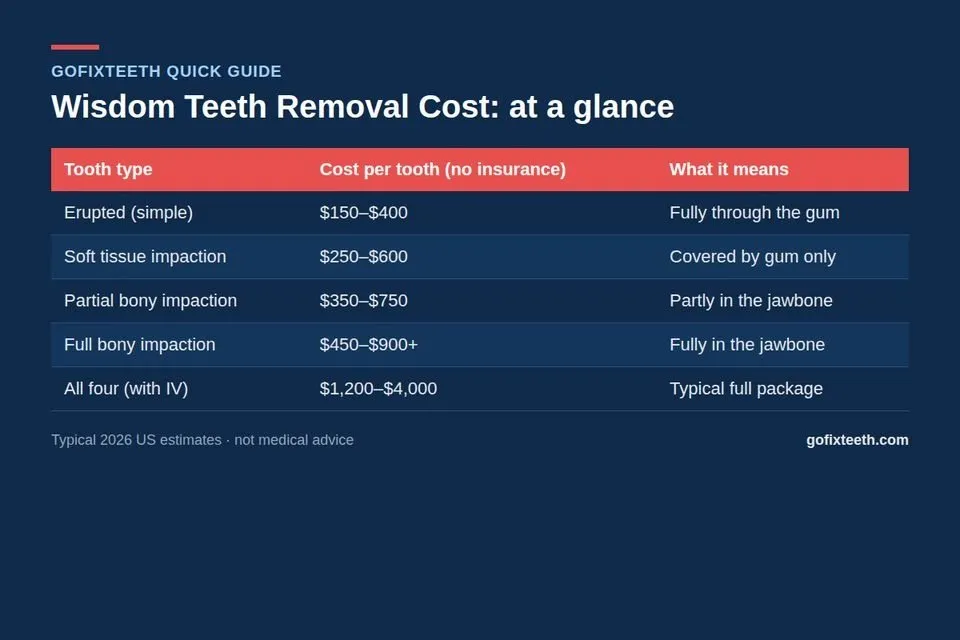
Wisdom tooth extraction cost per tooth (2026)
The biggest factor is how the tooth sits. A tooth that has fully come through the gum is removed much like any other tooth. A tooth trapped under gum or bone needs surgery, which takes more time and skill.
| Tooth type | Cost per tooth (no insurance) | What it means |
|---|---|---|
| Erupted (simple) | $150–$400 | Fully through the gum |
| Soft tissue impaction | $250–$600 | Covered by gum only |
| Partial bony impaction | $350–$750 | Partly in the jawbone |
| Full bony impaction | $450–$900+ | Fully in the jawbone |
| All four (with IV) | $1,200–$4,000 | Typical full package |
Typical 2026 US estimates; they vary by region and insurance. Fees are usually higher in large cities and with oral surgeons than with general dentists. A tooth growing at an awkward angle, like the cases in our guide to a wisdom tooth growing sideways, often falls into the bony impaction groups.
What the four types of extraction involve
Erupted (simple) extraction
If the tooth has come in fully and the roots are not unusual, a general dentist can often loosen and remove it under local anesthetic. This is the cheapest type and the quickest to recover from.
Soft tissue impaction
The crown of the tooth is under the gum but above the bone. The surgeon makes a small cut in the gum to reach it, then usually places a few stitches.
Partial bony impaction
Part of the tooth is still held by the jawbone. The surgeon removes a little bone and may cut the tooth into pieces so it comes out more easily. This takes longer and is billed at a higher code.
Full bony impaction
The tooth is completely inside the bone. This is the most involved type and the most expensive. If the roots are close to the nerve in the lower jaw, the surgeon may want a 3D scan first, which adds to the cost. More complex surgery also tends to mean a longer appointment, which raises sedation fees when they are billed by time.
Sedation, X-rays and other line items
The extraction fee is only part of the bill. Ask whether your estimate includes these:
- Consultation and exam: about $50–$200. Some surgeons waive it if you book the surgery.
- Panoramic X-ray: about $100–$250. It shows all four teeth and the roots.
- 3D cone beam (CBCT) scan: about $250–$600, only when the roots sit close to the nerve or sinus.
- Local anesthetic: usually included in the extraction fee.
- Nitrous oxide (laughing gas): about $50–$150.
- IV sedation: about $250–$800, often billed by time.
- General anesthesia: about $400–$1,200 or more, usually in a surgical center or hospital setting.
- Prescriptions and follow-up: pain medicine and a check-up visit, often modest.
Typical 2026 US estimates; they vary by region and insurance. Sedation is the line most people underestimate. Removing all four impacted teeth under IV sedation can cost almost twice as much as removing two erupted teeth with only local anesthetic.
Wisdom teeth removal cost with insurance
Insurance can cut the bill a lot, but the details matter. A common setup looks like this:
- Coverage of about 50–80% for oral surgery after the deductible, depending on the plan and whether the extraction is “basic” or “major”
- An annual maximum, often $1,000 to $2,000, which four impacted teeth plus sedation can use up
- Sedation rules: some plans pay for IV sedation only for bony impactions, or not at all
- Waiting periods on new plans, sometimes 6 to 12 months for surgery
- Medical insurance: in some cases, especially full bony impactions, infections or cysts, part of the cost can be billed to medical insurance. Ask the surgeon’s office to check.
For example, if four partial bony impactions plus IV sedation total $2,800 and your plan pays 80% after a $50 deductible up to a $1,500 maximum, the plan would pay $1,500 and you would owe about $1,300. Ask the office for a written estimate and a pre-treatment estimate from your insurer before you book.
Medicare Part A and Part B generally do not cover routine dental extractions, though some Medicare Advantage plans have dental benefits. Medicaid coverage for adults depends on your state, and many states cover medically necessary extractions for children and teens.
Useful on Amazon for this job
As an Amazon Associate we earn from qualifying purchases. Always confirm fit for your exact vehicle or ask your dentist.
The Dental Recovery & Savings Bundle includes 4 ready-to-use scripts to lower your dental bill, so you know what to ask the surgeon’s front desk about cash prices, sedation fees and payment plans before you say yes. It also has a printable day-by-day recovery calendar to follow after the surgery. Instant PDF, $12, 30-day money-back promise.
Get the savings scripts →
Wisdom tooth removal cost without insurance: how to save
- Ask for the cash price. Many offices offer a discount for paying in full at the visit. Ask for it in writing.
- Compare a general dentist and an oral surgeon. For erupted teeth, a general dentist may charge less. For deep impactions, a surgeon is usually the safer choice.
- Talk about sedation options. If your teeth are simple and you feel calm, local anesthetic with or without nitrous oxide costs far less than IV sedation. Your surgeon will tell you what is safe for your case.
- Reuse recent X-rays. If your dentist took a panoramic X-ray in the last year or so, ask to have it sent over.
- Dental schools and community clinics. Supervised students and federally funded health centers often charge less. The NIDCR keeps a list of low-cost options. See also our guide to free tooth extraction programs.
- Dental discount plans. Member offices agree to reduced fees. These are not insurance, so check the fee schedule first.
- FSA or HSA. Wisdom teeth removal is generally an eligible expense, so you pay with pre-tax money.
- Payment plans. In-office plans or healthcare credit can spread the cost. Watch for deferred interest if the balance isn’t paid off in time.
Is it worth paying to remove them?
Not every wisdom tooth has to come out. Teeth that grow in straight, can be cleaned well, and cause no problems may be left alone and watched with regular X-rays. Removal is more often advised when a tooth is impacted and causes pain, infection of the gum around it, decay in the tooth next to it, or a cyst. Your dentist or surgeon decides this from an exam and X-rays.
Waiting can sometimes raise the cost. Roots grow longer with age and the bone gets denser, which can make surgery harder and recovery slower. An infected tooth may also need antibiotics and an extra visit first. To understand the trade-offs, read what happens if you don’t get your wisdom teeth removed.
See a dentist promptly if…
- You have pain or swelling at the back of your jaw that doesn’t settle
- The gum over a partly erupted tooth is red, sore or has a bad taste
- You find it hard to open your mouth fully
- Pain gets worse a few days after an extraction instead of better, which can be a sign of dry socket
Seek emergency care right away, or call 911, for facial or neck swelling that is spreading, fever with jaw pain, bleeding that won’t stop with firm pressure, or trouble swallowing or breathing.
Frequently asked questions
How much does it cost to remove wisdom teeth without insurance?
Typically about $150 to $900 per tooth, or about $1,200 to $4,000 for all four with IV sedation, in the US in 2026.
Is it cheaper to remove all four at once?
Usually yes. You pay for one consultation, one set of X-rays and one sedation session instead of several, and you recover only once.
Why is sedation so expensive?
IV sedation and general anesthesia need trained staff, monitoring equipment and extra time, and they are often billed in time blocks.
Will my dental insurance cover wisdom teeth removal?
Most plans cover part of a needed extraction after the deductible, up to the annual maximum. Sedation coverage varies, so ask for a pre-treatment estimate.
Can a general dentist remove wisdom teeth?
Many general dentists remove erupted or simple wisdom teeth. Deeply impacted teeth are usually referred to an oral surgeon.
Sources
- Mayo Clinic. Impacted Wisdom Teeth.
- NHS. Wisdom Tooth Removal.
- Cleveland Clinic. Dry Socket.
- National Institute of Dental and Craniofacial Research. Finding Low-Cost Dental Care.
This article is for general education and does not replace advice from your dentist or oral surgeon, who can examine your teeth and give you an exact quote.


