Wisdom Tooth Growing Sideways: Risks, Removal, Cost
A wisdom tooth growing sideways (horizontal impaction): symptoms, risks to the tooth next to it, surgical removal, 2026 US costs and recovery time.
✅ Quick answer
A wisdom tooth growing sideways is called a horizontal impaction: the tooth lies on its side under the gum or bone and pushes into the roots of the molar in front of it. It usually can’t come in on its own, so dentists often recommend surgical removal, especially if it causes pain, infection, decay or damage to the second molar. Removing one horizontally impacted wisdom tooth typically costs about $400–$900 without insurance, plus sedation if you choose it. Typical 2026 US estimates; they vary by region and insurance.
Most people find out their wisdom tooth is growing sideways from an X-ray, not a mirror. The tooth is often hidden under the gum, so you may only notice a dull ache in the back of the jaw, a sore spot that keeps coming back, or food packing behind your last molar. Seeing the word “horizontal” on a treatment plan can sound alarming, but it is a common finding, and the path forward is usually clear once you understand what it means.
This guide explains how a sideways wisdom tooth differs from other impactions, the symptoms to watch for, why it can harm the tooth next to it, what the surgery involves, what it costs, and what recovery is really like.
📩 Important: after you sign up, open the email from Go Fix Teeth and tap Confirm. Your PDF opens right away. Not there? Check Spam or Promotions.
Types of wisdom tooth impaction (and where sideways fits)
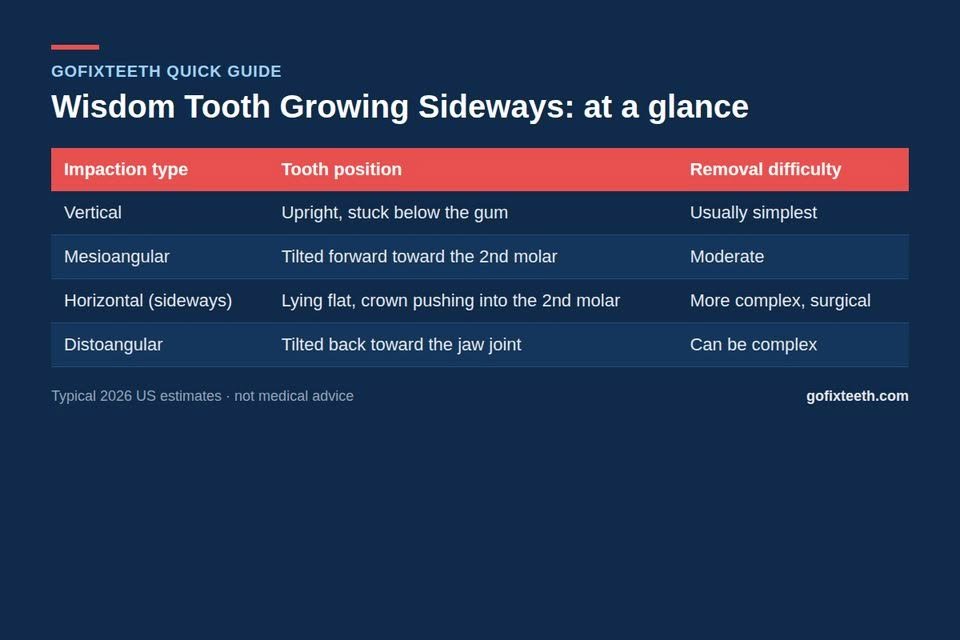
Dentists describe impacted wisdom teeth by the angle they sit at. Here is how a sideways tooth compares with the other common positions:

| Impaction type | Tooth position | Removal difficulty |
|---|---|---|
| Vertical | Upright, stuck below the gum | Usually simplest |
| Mesioangular | Tilted forward toward the 2nd molar | Moderate |
| Horizontal (sideways) | Lying flat, crown pushing into the 2nd molar | More complex, surgical |
| Distoangular | Tilted back toward the jaw joint | Can be complex |
A tooth can also be partly impacted (part of it shows through the gum) or fully impacted (completely covered by gum or bone). A sideways tooth that is fully covered by bone is generally the most involved type to remove, because the surgeon has to reach it and usually divide it into pieces.
Symptoms of a wisdom tooth growing sideways
Some sideways wisdom teeth cause no symptoms for years. When they do cause trouble, common signs include:
- Pain or pressure at the back of the jaw, sometimes spreading toward the ear
- Red, swollen or tender gum behind the last molar
- Bad taste or bad breath that doesn’t go away with brushing
- Food getting stuck behind or between the back teeth
- Pain when chewing on that side, or sensitivity in the second molar
- Jaw stiffness or trouble opening your mouth fully
When the tooth is partly through the gum, a flap of tissue can trap bacteria and become infected. This is called pericoronitis, and it is one of the most common reasons people end up needing a wisdom tooth out. If the gum or the tooth is rubbing the inside of your cheek, see our guide to a wisdom tooth cutting into your cheek.
Why a sideways wisdom tooth can damage the second molar
The biggest concern with a horizontal wisdom tooth is often not the wisdom tooth itself but the healthy molar in front of it. Because the sideways tooth presses against the back of that molar, a few problems can develop over time:
- Decay on the back of the second molar. The space where the two teeth meet is almost impossible to clean. Plaque collects there, and a cavity can form in a spot that is hard to see and hard to fill.
- Bone loss and gum pockets. The bone between the two teeth can wear away, which can weaken the support of the second molar.
- Root damage. In some cases the pressure can wear into the root of the neighboring tooth.
- Cysts. Less commonly, a fluid-filled sac can form around an impacted tooth and damage the surrounding bone.
These problems can develop quietly, without pain. That is why dentists often check a sideways wisdom tooth with X-rays even when you feel fine. Mayo Clinic notes that impacted wisdom teeth can lead to damage to nearby teeth, cysts, decay and gum disease. To understand the long-term picture, read what happens if you don’t get your wisdom teeth removed.
Does a sideways wisdom tooth always need to come out?
Not always, but often. A horizontal tooth almost never straightens up and comes in normally, so “wait and see” mainly makes sense when the tooth is fully buried, causing no symptoms, and showing no signs of harm to nearby teeth or bone. In that case, your dentist may suggest monitoring it with X-rays at regular checkups.
Removal is more likely to be recommended when there is repeated infection, pain, decay on the second molar, gum disease around the back teeth, a cyst, or damage to nearby roots. Age also plays a part: the roots are usually not fully formed in younger adults, and many surgeons find that healing tends to be easier earlier in life. Your dentist or oral surgeon will weigh these factors for your specific case.
Useful on Amazon for this job
- Cold/hot face wrap for jaw swelling
- Irrigation syringe for extraction sites
- Soft-food blender bottle
As an Amazon Associate we earn from qualifying purchases. Always confirm fit for your exact vehicle or ask your dentist.
The Dental Recovery & Savings Bundle gives you a printable day-by-day recovery calendar for the first week after extraction, plus 4 ready-to-use scripts to lower your dental bill before you agree to the surgeon’s quote. Instant PDF, $12, 30-day money-back promise.
Get the recovery calendar →
How a sideways wisdom tooth is removed
A horizontal wisdom tooth is removed surgically, usually by an oral surgeon, though some general dentists do these as well. The steps are fairly standard:
- Imaging. A panoramic X-ray shows the tooth’s angle and depth. If the roots sit close to the nerve in the lower jaw, a 3D cone-beam scan may be ordered.
- Anesthesia. Local numbing is always used. Many people also choose nitrous oxide, oral sedation or IV sedation so they are relaxed or asleep.
- Access. The surgeon makes a small cut in the gum and may remove a little bone over the tooth.
- Sectioning. Because a sideways tooth is wedged against the second molar, it is usually cut into two or more pieces so it can come out without harming the neighboring tooth.
- Closing. The area is cleaned, and stitches are often placed. Many are the dissolving type.
The procedure itself often takes well under an hour per tooth, though appointment time is longer with sedation. If you have a surgery date, our checklist on how to prepare for wisdom teeth removal covers what to arrange beforehand, like a ride home and soft foods.
Possible risks
Your surgeon will explain the risks for your case. The most discussed are dry socket (when the blood clot is lost too early), infection, and, for lower teeth near the nerve, temporary or rarely longer-lasting numbness of the lip, chin or tongue. The NHS notes that removal is a common procedure and that most people recover without problems.
Wisdom tooth growing sideways: removal cost in 2026
Because a horizontal impaction usually needs surgery, it costs more than pulling a tooth that has already come in. Typical fees without insurance:
- Partial bony or soft tissue impaction: about $250–$700 per tooth
- Full bony horizontal impaction: about $400–$900 or more per tooth
- Panoramic X-ray: about $100–$250; a 3D scan about $150–$500
- IV sedation or general anesthesia: about $250–$900, often billed by time
- All four wisdom teeth with sedation: often about $1,500–$4,000 total
Typical 2026 US estimates; they vary by region and insurance. Dental insurance often treats impacted wisdom tooth removal as oral surgery and may cover around 50% to 80% after the deductible, up to your annual maximum. Some medical plans cover part of the cost when the tooth is causing infection or damage, so ask the office to check both. If cost is a concern, the National Institute of Dental and Craniofacial Research lists dental schools and community clinics that may charge less.
Recovery after removing a sideways wisdom tooth
Recovery from a horizontal impaction can take a little longer than from a simple extraction because bone was involved. A typical timeline:
- First 24 hours: some bleeding and oozing, numbness wearing off, and the start of swelling. Bite on gauze and rest with your head raised.
- Days 2–3: swelling and jaw stiffness usually peak. Cold packs help early; your surgeon may suggest warm compresses later.
- Days 4–7: pain and swelling should steadily improve. Most people return to work or school within a few days to a week.
- Weeks 2–4: the gum closes over, though the bone underneath keeps healing for longer.
Pain that gets worse after day 3, a bad taste, or an empty-looking socket can be signs of dry socket, so call your surgeon. For detailed do’s and don’ts, see our wisdom teeth removal aftercare guide.
See a dentist promptly if…
- The gum behind your last molar is swollen, sore or oozing
- You have ongoing pain at the back of your jaw or near your ear
- You notice a bad taste or smell that keeps coming back
- Your second molar has become sensitive or painful
Seek emergency care right away for facial or neck swelling that is spreading, fever with jaw pain, or trouble opening your mouth, swallowing or breathing. These can be signs of a serious infection.
Frequently asked questions
Can a sideways wisdom tooth straighten on its own?
It is very unlikely. A horizontally impacted tooth usually stays in that position, which is why dentists either monitor it or recommend removal.
Does a sideways wisdom tooth push your other teeth crooked?
This is debated among dentists. Many feel wisdom teeth are not the main cause of crowding in the front teeth, but a sideways tooth can clearly affect the molar right next to it.
Is removing a horizontal wisdom tooth painful?
You should not feel pain during the procedure because of the anesthesia. Soreness and swelling afterward are normal for a few days and are usually managed with medicine your surgeon recommends.
How long does it take to remove a sideways wisdom tooth?
The surgery itself often takes about 20 to 60 minutes per tooth, depending on depth and how close it is to the nerve.
Will insurance cover a horizontal impaction?
Many dental plans cover part of it as oral surgery. Ask for a pre-treatment estimate, and ask whether your medical plan applies if there is infection.
Sources
- Mayo Clinic. Impacted Wisdom Teeth.
- NHS. Wisdom Tooth Removal.
- MedlinePlus. Tooth Disorders.
- National Institute of Dental and Craniofacial Research. Finding Low-Cost Dental Care.
This article is for general education and does not replace advice from your dentist or oral surgeon, who can examine your X-rays and recommend the right treatment for you.