
When Do Wisdom Teeth Come In? Ages, Signs & Next Steps
When do wisdom teeth come in? Usually ages 17 to 25. Learn the signs, what it means if they never erupt, impaction, and when to see a dentist.
✅ Quick answer
Wisdom teeth (third molars) usually come in between the ages of 17 and 25, although some people see them earlier or later and some never get them at all. Common signs include pressure or a dull ache behind the last molars, sore or swollen gums at the back of the mouth, and a tooth tip poking through the gum. If they have no room, they can stay stuck (impacted), which is why dentists track them with X-rays in the late teens.
Wisdom teeth are the last adult teeth to form, and they arrive long after the rest of your smile is settled. For some people they slide in without a fuss. For others they push against the teeth in front, get stuck in the jaw, or come in only partway and trap food.
This guide covers the typical age range, how wisdom teeth develop, the signs they are coming in, what happens if they don’t come in, and when it is time to see a dentist.
📩 Important: after you sign up, open the email from Go Fix Teeth and tap Confirm. Your PDF opens right away. Not there? Check Spam or Promotions.
Wisdom teeth timeline by age
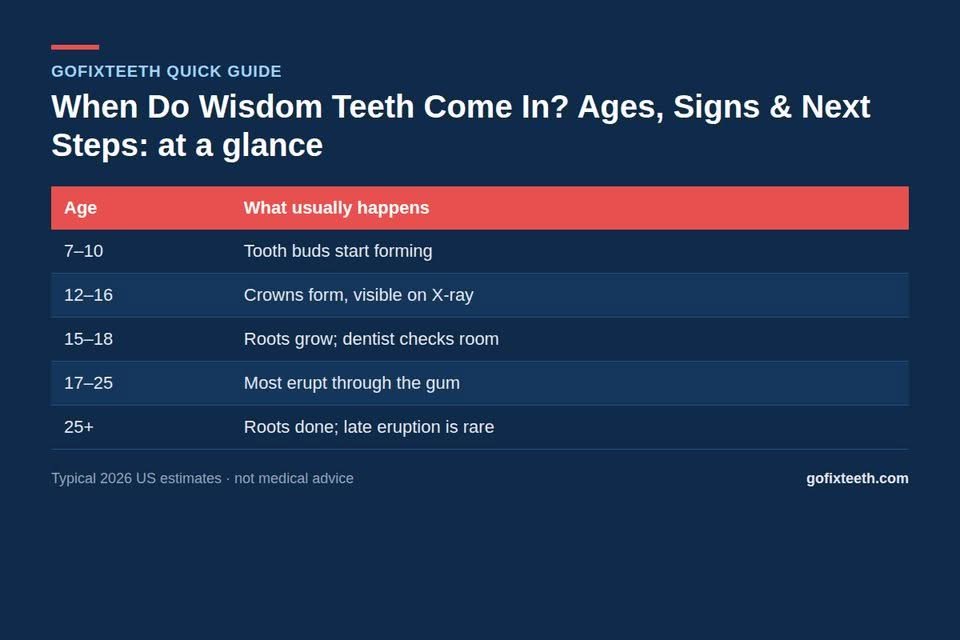
Every mouth is different, but this is the usual order of events:

| Age | What usually happens |
|---|---|
| 7–10 | Tooth buds start forming |
| 12–16 | Crowns form, visible on X-ray |
| 15–18 | Roots grow; dentist checks room |
| 17–25 | Most erupt through the gum |
| 25+ | Roots done; late eruption is rare |
These are general ranges, not rules. A few people get wisdom teeth in their early teens, and some adults notice one breaking through in their thirties, often because it was partly stuck for years. It is also common to have fewer than four, or none at all.
Why they come in so late
Wisdom teeth form last because the jaw needs time to grow. They develop at the very back of the jaw, behind the second molars, and only start to move up once their roots have begun to form. By then the other teeth have taken most of the space. That is the main reason wisdom teeth so often come in crooked, partly, or not at all.
The nickname comes from the idea that they show up at an age when you are older and “wiser” than when the other teeth arrived.
Signs your wisdom teeth are coming in
- A dull ache or pressure behind your last molars, on one or both sides
- Tender, red or puffy gums at the very back of the mouth
- A small white tooth edge showing through the gum
- Jaw stiffness or mild pain when opening wide
- Food getting trapped in a flap of gum over a partly erupted tooth
- Bad breath or a bad taste from that area
- Headache or ear-area pain on the same side, in some people
Mild soreness that comes and goes can be normal while a tooth erupts. Pain, swelling and a bad taste that keep coming back often point to an infection of the gum flap (called pericoronitis), which a dentist should check.
What if wisdom teeth don’t come in?
There are a few different reasons you might not see your wisdom teeth:
They never formed
Many people are missing one or more wisdom teeth. An X-ray is the only way to know. If they are not there, there is nothing to treat.
They are impacted
An impacted wisdom tooth is stuck under the gum or in the bone because there is no room or it is growing at an angle. Some point forward into the next molar, some sit sideways, and some lie flat. Read more in our guide to a wisdom tooth growing sideways.
Impacted teeth don’t always cause trouble, but they can lead to gum infections, decay or damage to the tooth in front, crowding, and in some cases a fluid-filled cyst in the jaw. That is why dentists often recommend X-rays to monitor them even when nothing hurts.
They are partly erupted
A tooth that pokes through only part way leaves a gum flap that is hard to clean. This is the setup most likely to cause repeated swelling and infection.
If you are deciding whether to have them out, see what happens if you don’t get your wisdom teeth removed.
Useful on Amazon for this job
As an Amazon Associate we earn from qualifying purchases. Always confirm fit for your exact vehicle or ask your dentist.
The Dental Recovery & Savings Bundle gives you a printable day-by-day recovery calendar to follow after the surgery, plus 4 ready-to-use scripts to lower your dental bill when you talk to the surgeon’s office about the quote. Instant PDF, $12, 30-day money-back promise.
Get the recovery bundle →
When should wisdom teeth be checked?
Many dentists like to look at wisdom teeth on a panoramic X-ray in the mid to late teens. At that age the roots are usually not fully formed, so if removal is needed, surgery tends to be simpler and healing faster. That doesn’t mean every teen needs them removed. Healthy wisdom teeth that come in straight, bite properly and can be cleaned may be kept.
Your dentist will usually look at:
- Whether there is enough room for the tooth to come in fully
- The angle of the tooth and how close the roots are to the nerve in the lower jaw
- Signs of decay, gum disease or cysts around the tooth
- Whether you can reach the tooth with a toothbrush and floss
If removal is advised, our guides on wisdom teeth removal cost and how to prepare for wisdom teeth removal can help you plan.
Keeping wisdom teeth healthy if you keep them
If your dentist says your wisdom teeth can stay, they still need extra attention. They sit so far back that they are easy to miss with a toothbrush, and decay or gum disease there can spread to the second molar in front.
- Angle your brush toward the back and open only slightly so your cheek doesn’t block the brush.
- Try a smaller-headed or end-tuft brush to reach behind the last tooth.
- Floss between the wisdom tooth and the molar in front every day.
- Keep regular checkups so your dentist can watch the area on X-rays over time.
How to ease mild discomfort while they come in
If a dentist has checked the tooth and it is simply erupting, these steps may help with mild soreness:
- Rinse with warm salt water a few times a day, especially after eating.
- Keep the area clean. Brush gently at the back and use floss or a small brush around the gum flap.
- Use a cold pack on the outside of the cheek for short periods.
- Over-the-counter pain relievers can help when used as directed on the label. Ask a pharmacist or doctor if you have health conditions or take other medicines.
- Chew on the other side and avoid hard foods near the sore spot.
These steps ease symptoms but don’t fix an impacted or infected tooth. If pain keeps returning, get it checked rather than managing it at home for months.
See a dentist promptly if…
- Pain at the back of your mouth lasts more than a few days or keeps coming back
- The gum over a wisdom tooth is swollen, leaks pus or tastes bad
- You can’t open your mouth fully or it hurts to chew
- The tooth in front of a wisdom tooth starts to hurt or feels sensitive
- You have never had your wisdom teeth checked on an X-ray and you are in your late teens or older
Seek emergency care right away, or call 911, for swelling of the face or neck that is spreading, fever with jaw pain, or trouble swallowing or breathing. These can be signs of a serious infection.
Frequently asked questions
Can wisdom teeth come in at 30?
It is less common, but a partly impacted tooth can shift or break through later in life. A dentist can check it on an X-ray.
How long does it take for a wisdom tooth to come in?
It varies. Eruption can happen over months, and soreness often comes in waves rather than all at once.
Is it normal to have only two wisdom teeth?
Yes. Many people are missing one or more wisdom teeth, and that is usually not a problem.
Do wisdom teeth always need to be removed?
No. Healthy, well-positioned wisdom teeth that you can keep clean may stay. Your dentist decides based on an exam and X-rays.
Can wisdom teeth cause crowding of the front teeth?
This is debated among dentists. Teeth can shift for many reasons, so ask your dentist or orthodontist about your specific case.
Sources
- Mayo Clinic. Impacted Wisdom Teeth.
- NHS. Wisdom Tooth Removal.
- MedlinePlus. Tooth Disorders.
- MedlinePlus. Dental Health.
This article is for general education and does not replace advice from your dentist, who can examine your teeth and X-rays and tell you what is right for you.


